
Media Studies A-level
The Archive offers a wealth of material that supports Media Studies A Level.
To make it easy for you to find the material you need, we have highlighted links to content signposted to the Cambridge OCR A Level in Media Studies.
Media Messages (Component 1)
Section A:
News and Online Media
– How have audiences for newspapers changed over time?
1: Overview
The first newspapers in Britain emerged in the early 16th century but were slow to evolve with a largely illiterate population. Several hundred years later, as the 19th century progressed, a combination of improvements in printing technology and mass education led to a boom in newspaper publishing. By the 20th century there were well established national newspapers and a raft of regional and local press.
This paper focuses largely on the national newspapers across the UK, drawing upon data and articles which can be found in the Archive of Market and Social Research. We have looked at trends across the 20th century up to 2022 when the impact of the Internet and widespread mobile phone adoption had changed the industry irrevocably.
In the first half of the 20th century data and surveys were limited. Circulation data was available but until the 1930s wasn’t produced in a consistent way across titles. Readership of newspapers was measured on occasional surveys but again the measures were inconsistent until a national readership survey was developed in 1956.[1]
Newspapers grew to be a vital medium for news, information and entertainment across the 20th century. They also became a key tool for advertisers to reach large audiences, benefitting also from the fact that each title was specifically targeted at a particular demographic audience and outlook.
As the 21st century dawned there was increasing competition particularly from online players challenging the role that newspapers had played in disseminating news and information and influencing opinion. But, newspaper businesses have adapted their offers online. Some newspaper brands reach some of the biggest audiences online in the UK. They continue to be highly differentiated and attract very different audiences from each other.
Key points:
-
- A growth of newspaper audiences across the first half of the 20th century to almost universal readership by the early 1960s.
- By the mid 20th century they were the key means by which people accessed news and information. As well as reaching large and targeted audiences for advertising they became a powerful means of influencing political opinion.
- Newspaper titles are clearly targeted at specific audiences in terms of income, class, age and outlook.
- Newspapers withstood competition from initially radio and then TV, retaining their importance throughout significant changes in lifestyle and society
- By the end of the 20th century they faced the biggest change to date; the Internet was becoming widespread and the adoption of mobile phones accelerated this change.
- In the 21st century printed newspapers are in decline but most titles have evolved and survived by adapting content and positioning. Some of the largest online sites and apps in this country are newspaper brands such as the Daily Mail or Guardian, attracting large and still targeted audiences online.
2: The 20th Century – pre-WW2 (up to 1939)
-
- Newspaper readership grew – by the 1930s over two thirds of the British population read a newspaper each day
- Over this period we see a growth in reading among the working classes and the success of the “popular” titles such as the Daily Mirror and the Daily Herald
- The profile of readers to each title was clearly differentiated, particularly by social class
- Radios became more prevalent in households and provided direct competition in terms of news coverage, particularly after the launch of the BBC in the 1920s
Newspapers grew in importance over this period with both national titles and a raft of local and regional press.
Readership research was rare in the pre war era but there is a fascinating report by the London Bureau, published in 1928 “Press Circulations Analysed”, which gives us an insight into the market.
In the chart below we can see household levels of readership of the main morning daily newspapers (national titles).
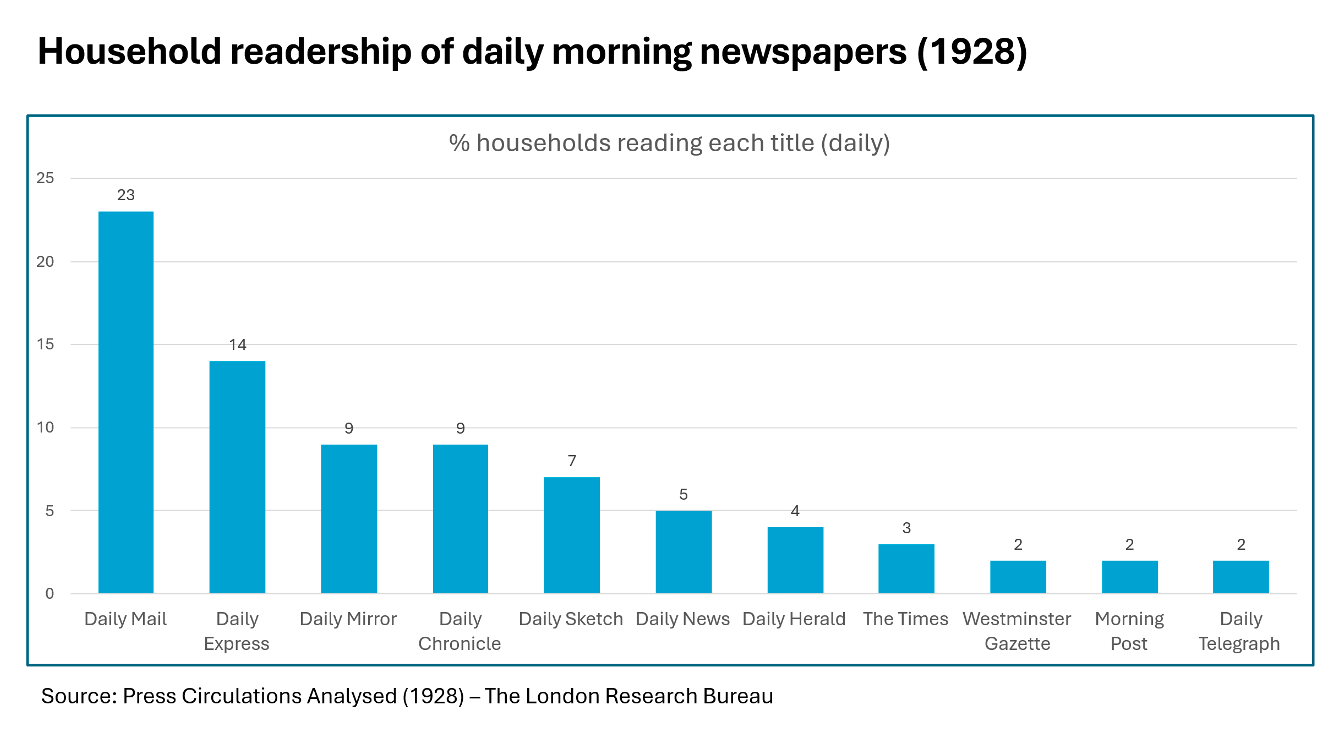
Some titles are recognisable, even in the modern era; others have disappeared or merged into their competitors. A good example of this is the “Daily News” which was actually founded by Charles Dickens in 1843 but by 1930 merged with the News Chronicle which in turn ceased publication in 1960 and was absorbed into the Daily Mail.
Social class* was a familiar concept in the early 20th Century and we can see clear differences in the audience to each title. While the Times was only typically read by about 3% of households on a daily basis it was clearly focused on the “middle classes”, those with more buying power and influence. In contrast the Daily Herald strongly appealed to the working class. This newspaper began publishing in 1911, initially as a daily strike bulletin in support of the printers’ union, the London Society of Compositors. Throughout its history it had links to the Labour movement and unions. In 1964 it ceased publication and later relaunched as the Sun.
* Interestingly in this study the decision on household class was made by the interviewer themselves. The researchers describe class as “buying capacity and social outlook”: “By class we mean buying capacity-plus social outlook. By middle-class we mean the well-to-do and the comfortably-off. By lower middle-class we mean people whose buying-capacity is much more limited than the middle-class, but whose social outlook and buying-habits are somewhat similar to those of people in that class. By working-class we mean the steadier types of workers.”
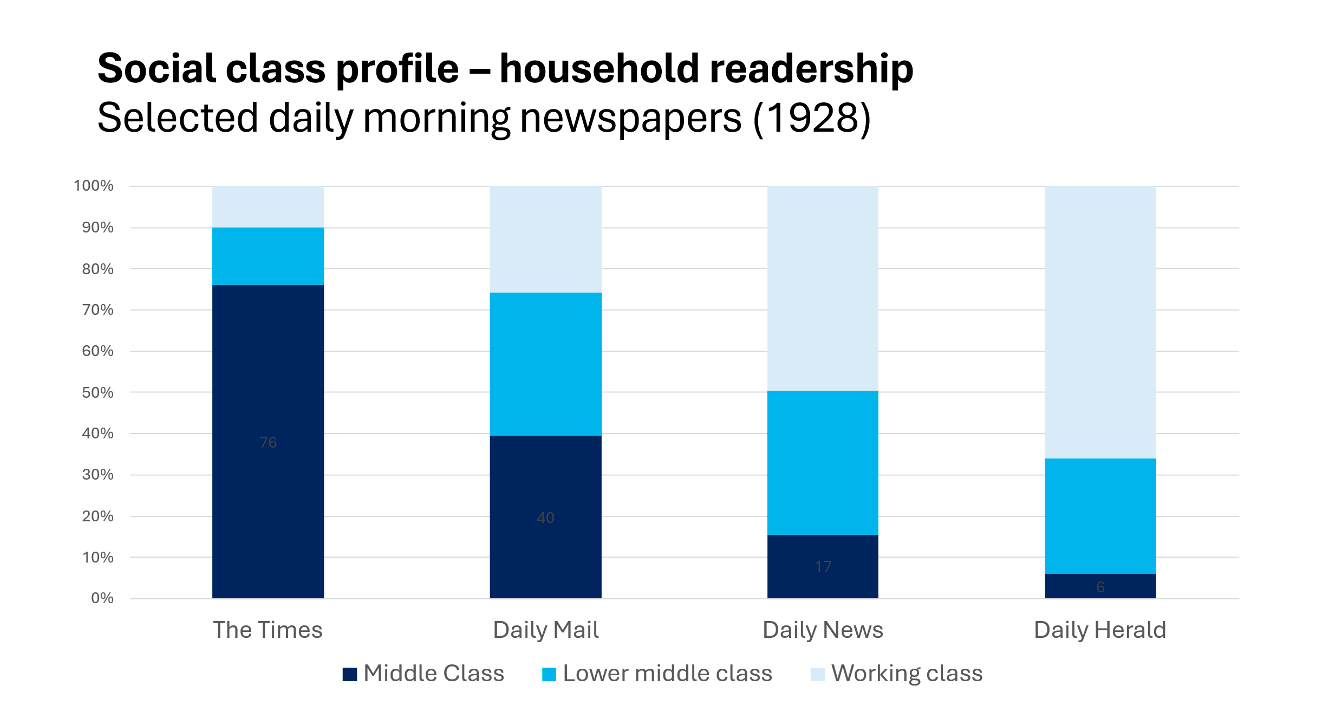
In the 1930s newspapers started to move more widely into the working class market and titles such as the Daily Herald and the Daily Mirror grew in popularity. And so newspaper readership widened to represent a large proportion of the UK population. By the 1930s over two thirds of the population read a newspaper every day with “almost everyone” taking one on Sunday‡.
There was competition to newspapers. Radios became a more common feature in households and clearly competed with the papers in terms of news coverage. In the 1920s the BBC launched, initially they had restrictions on news reporting but these were loosened by the time of the second world war. Consequently, the news gathering operation of BBC radio expanded and it became the leading way in which news was broken. Newspapers had to adapt their coverage to stay relevant and continue their appeal to a large audience.
‡ Adrian Bingham: Monitoring the Popular Press (2005)
3: Mid-Century – the '50s and '60s
-
- Mid 20th century was the peak period for newspaper audiences
- In the early 1950s around 85% of the population read a newspaper each day
- Newspapers were highly influential and an important means of disseminating news, influencing political opinion and reaching audiences for advertising
- Among the quality press The Daily Telegraph and the Sunday Times were market leaders and continued to grow
- TV was starting to emerge as a serious competitor for news coverage and leisure time. By the 1960s it had become a common household item.
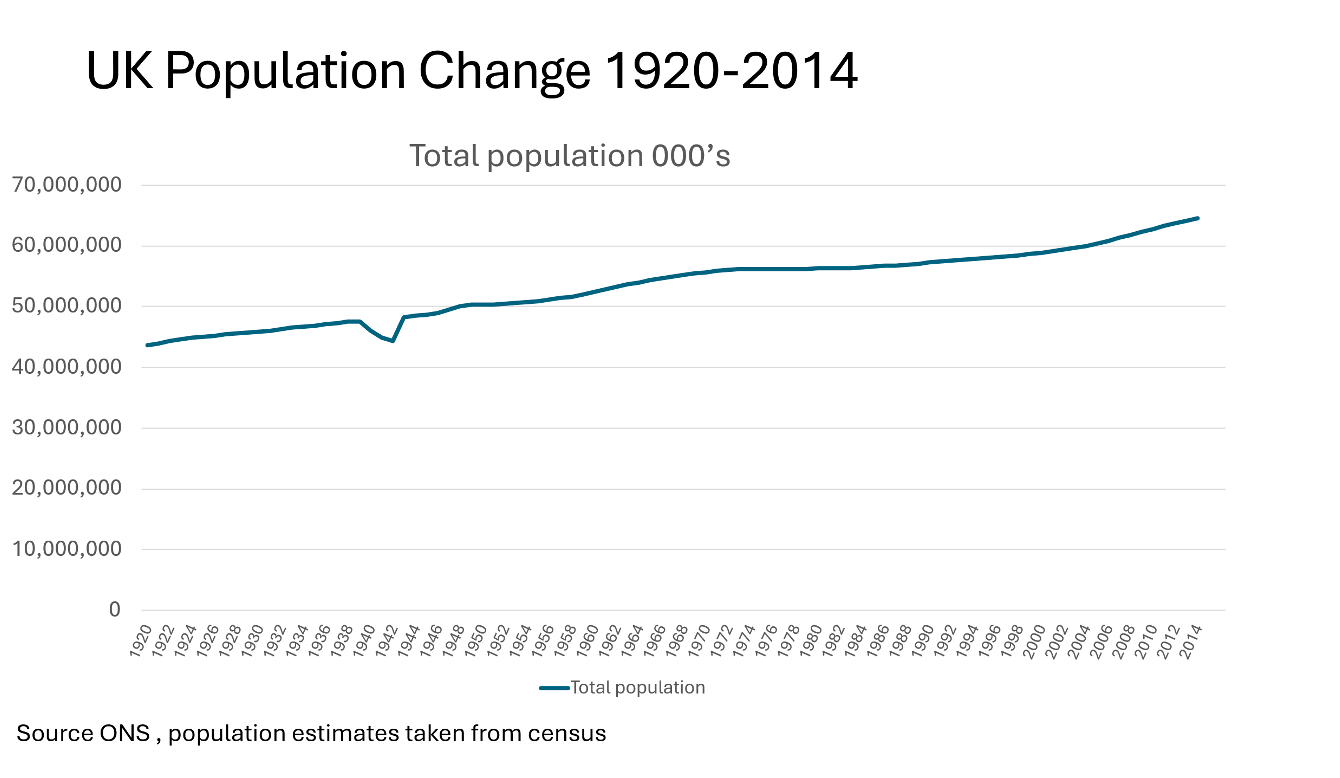
This was the peak period for newspapers. Reading of newspapers was a dominant, mass market cultural activity. At the same time the British population was growing, adding to the numbers of readers. (See also appendices for relevant UK population figures)
In the early 1950s, Britain was a “nation of readers,” with around 85% of the adult population reading a newspaper each day. Circulations were at their peak, driven by a high demand for news and advertising. Newspapers were a central source of information and a highly profitable industry, attracting significant investment.
Newspapers were especially important to British culture and the media landscape, more widely read than any other country. They were the main means of finding out information about the world, politics and public life.
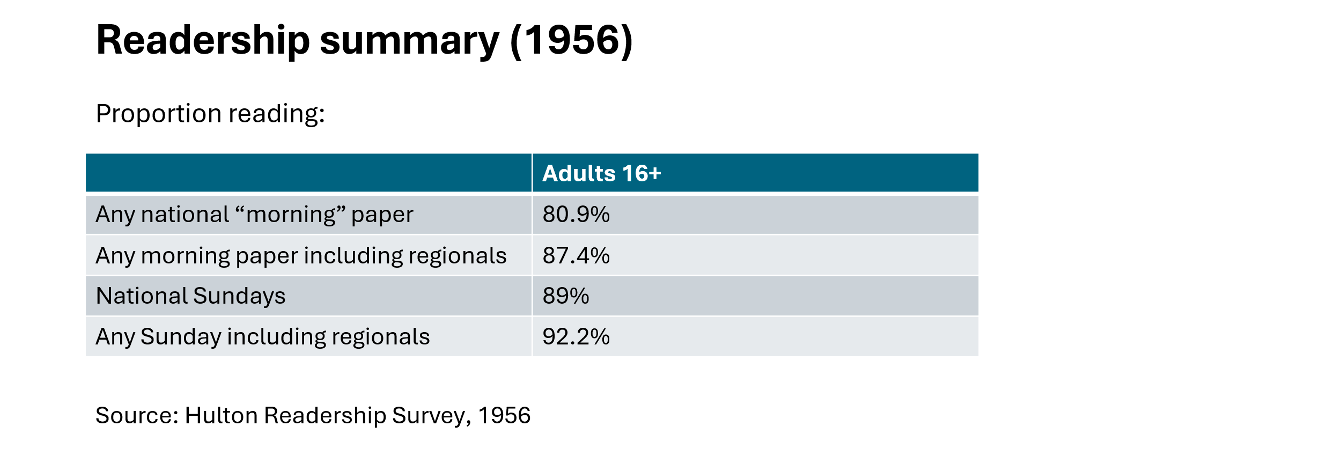
In 1956 the first of many years of national readership research began; the Hulton Readership Survey measured all national newspapers on a continuous basis. Data from the survey shows how extensively newspapers touched the population with almost 9 in 10 adults reading a morning title (national morning/daily newspaper or regional title published in the morning) and 92% reading any Sunday newspaper.
Around this time newspapers felt the initial competition from the relatively new medium of television. Penetration of TV sets grew across the 1950s and 1960s offering more immediate news updates and competition for people’s leisure time. As a result, titles began to adapt and differentiate their offer. Quality titles like the Times, Telegraph and Guardian provided more detail and depth. Using these strategies circulations of the quality titles were maintained or in most cases grew – most notably the Sunday Times which grew to market leader by 1966.

(Hand-drawn chart from original report)
Note: Circulations are the number of copies distributed to newsagents and retailers on an average day as given by Audit Bureau of Circulation. It is closer measure to sales than readership which measures the number of people who have read or seen a copy.
Meanwhile the popular newspapers adapted in very different ways – by moving downmarket and providing things TV did not. More scandal, more sex, more crime and celebrity coverage that TV, at the time, wasn’t covering.
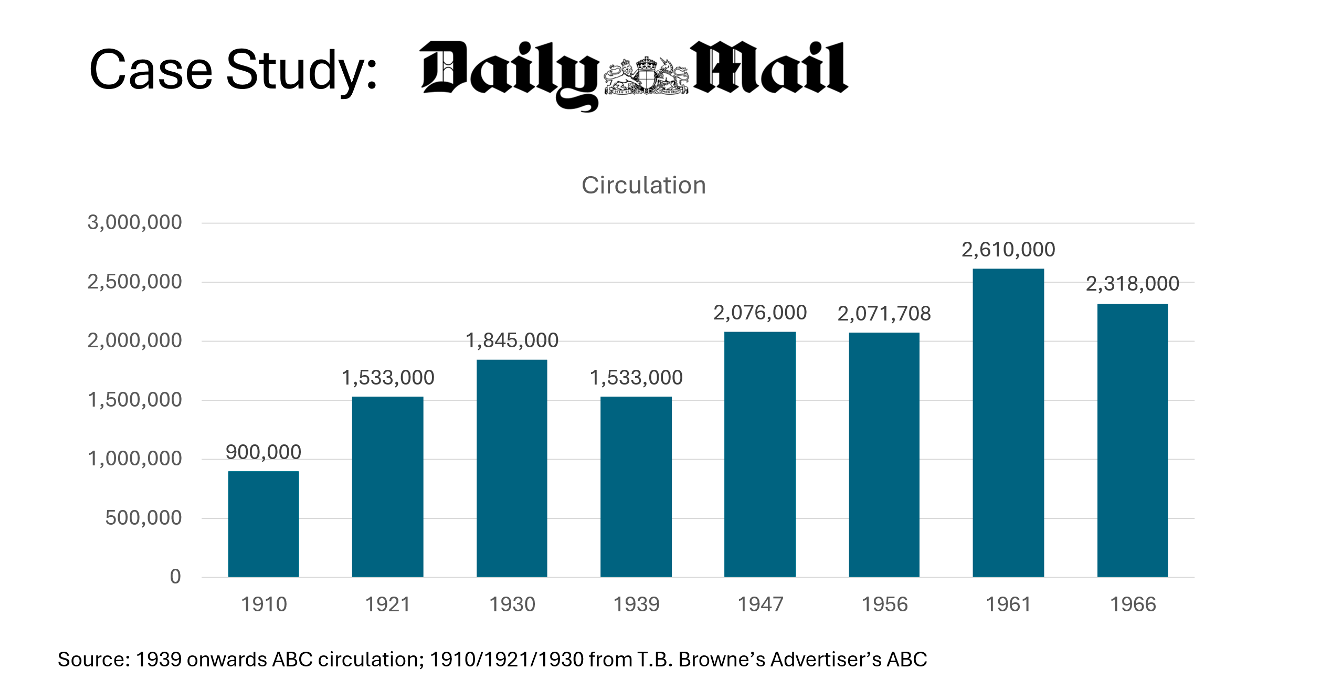
Taking the example of the Daily Mail which was a mid market, highly successful title we can see consistent growth peaking in the early 1960s. After this point competition from TV and changes in lifestyle led to a decline.
4: Gradual Decline – the '70s to the '90s
-
- Newspapers remain an important medium, read by more than half of the population
- Changes in working patterns and lifestyle impact on time available to read
- Greater competition from TV, particularly as channels expand and viewing on demand (initially through video recorders) becomes popular
- Newspaper titles adapt to competition and become more targeted at particular audiences – demographics and outlook
- The decline in readership was most noticeable among C2DE households and the tabloid, popular titles
- Readership of Sunday newspapers declined more than dailies
- Readership among younger adults, aged under 35 started to decline from the 1980s
TV grew rapidly both in terms of household ownership and channels available to view over this period. Television offered an alternative, immediate source of news and entertainment, competing for the public’s attention and leisure time. While newspaper readership remained significant for several decades, this new medium began a slow, steady erosion of print sales. Lifestyle changes, such as more women entering the workforce and the standard 9-to-5 workday becoming less common also meant people had less time for newspapers.
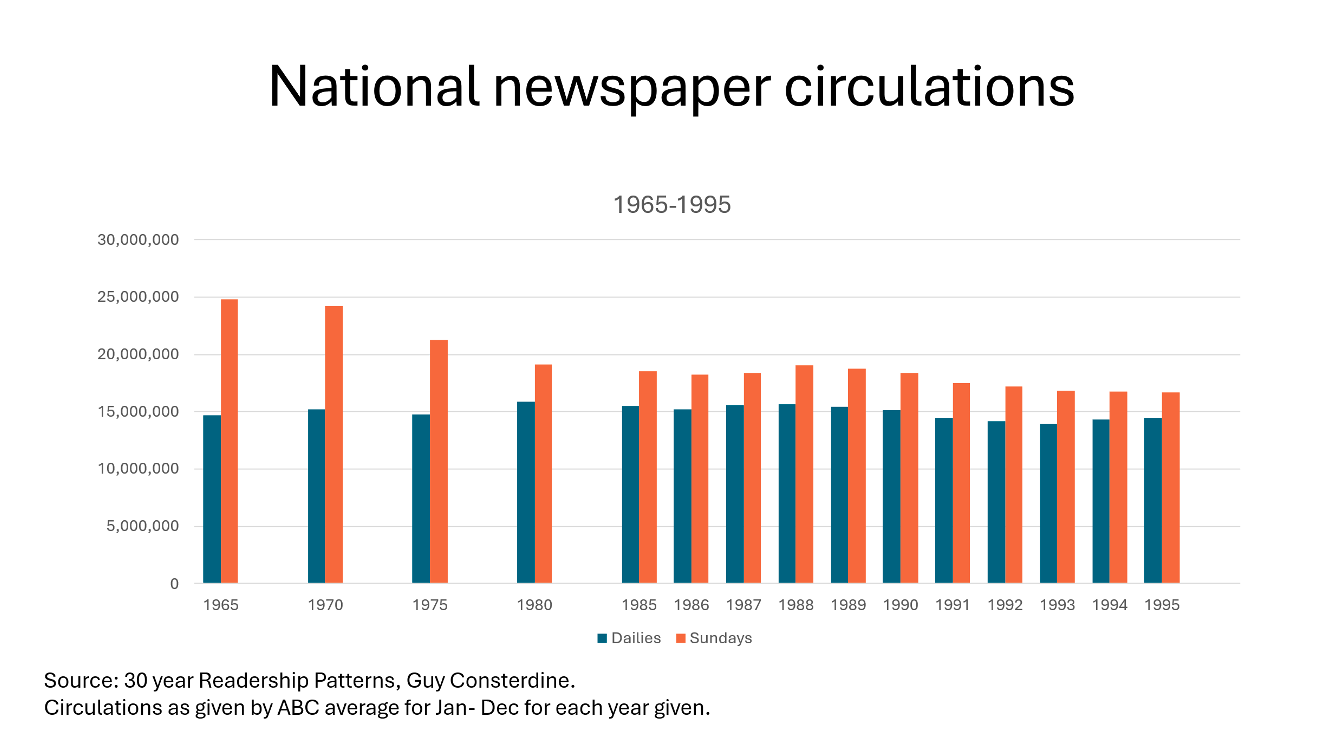 While daily newspaper circulations remained largely stable over this extended period, Sundays showed a significant decline from the mid 1960s to the mid 1980s. In 1965 the average circulation for the Sunday newspapers was almost 25 million; 30 years later this number had dropped by a third to just over 16 million copies.
What might have driven this change? Think about competing media, changes in leisure time and changing household dynamics.
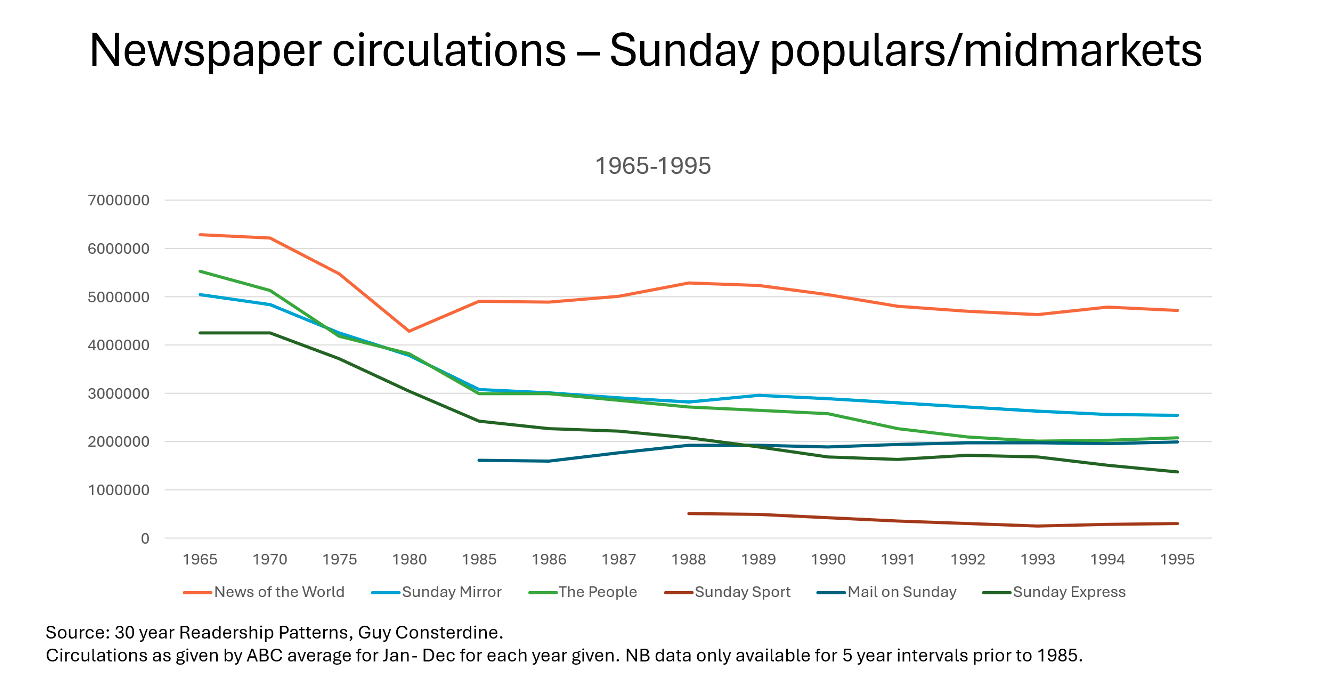
In particular, the decline came from the popular and mid-market titles:
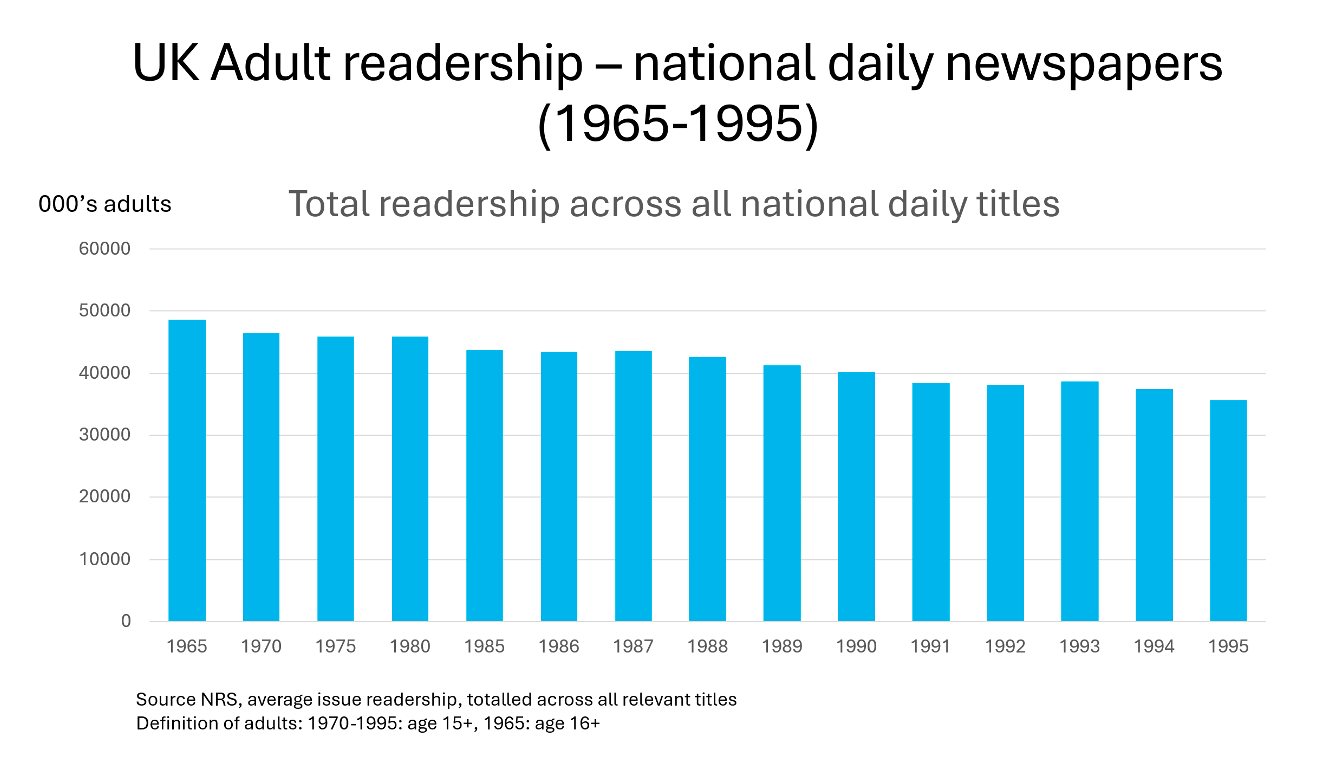
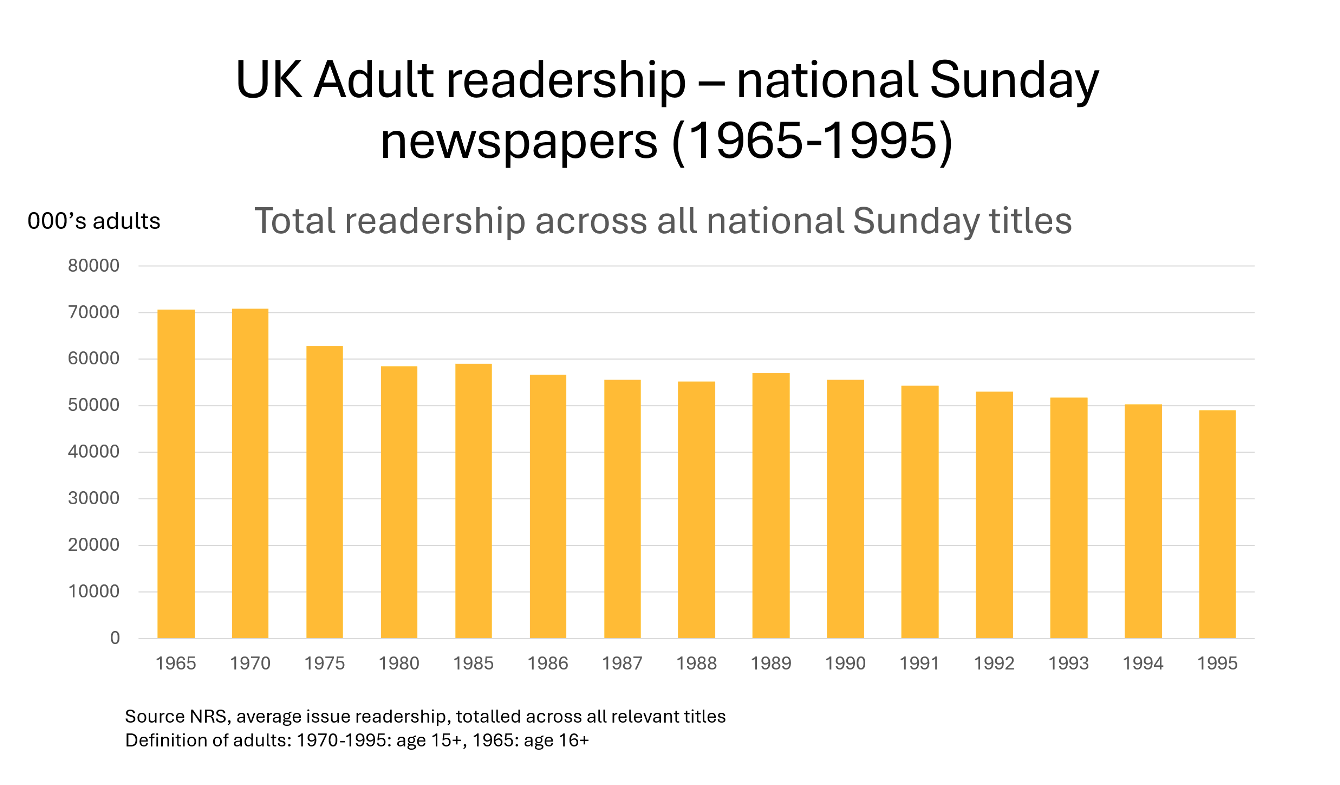
 So who was reading newspapers? At this time we have access to more research with consistent measures of reading taken from large, ongoing surveys.
We can see that newspapers reached large numbers of the population and while these overall numbers fell from the 1960s to the mid 90s the decline was relatively slow. Again more significant among Sunday newspapers than the dailies.
 How did changes in readership vary by different demographic groups?
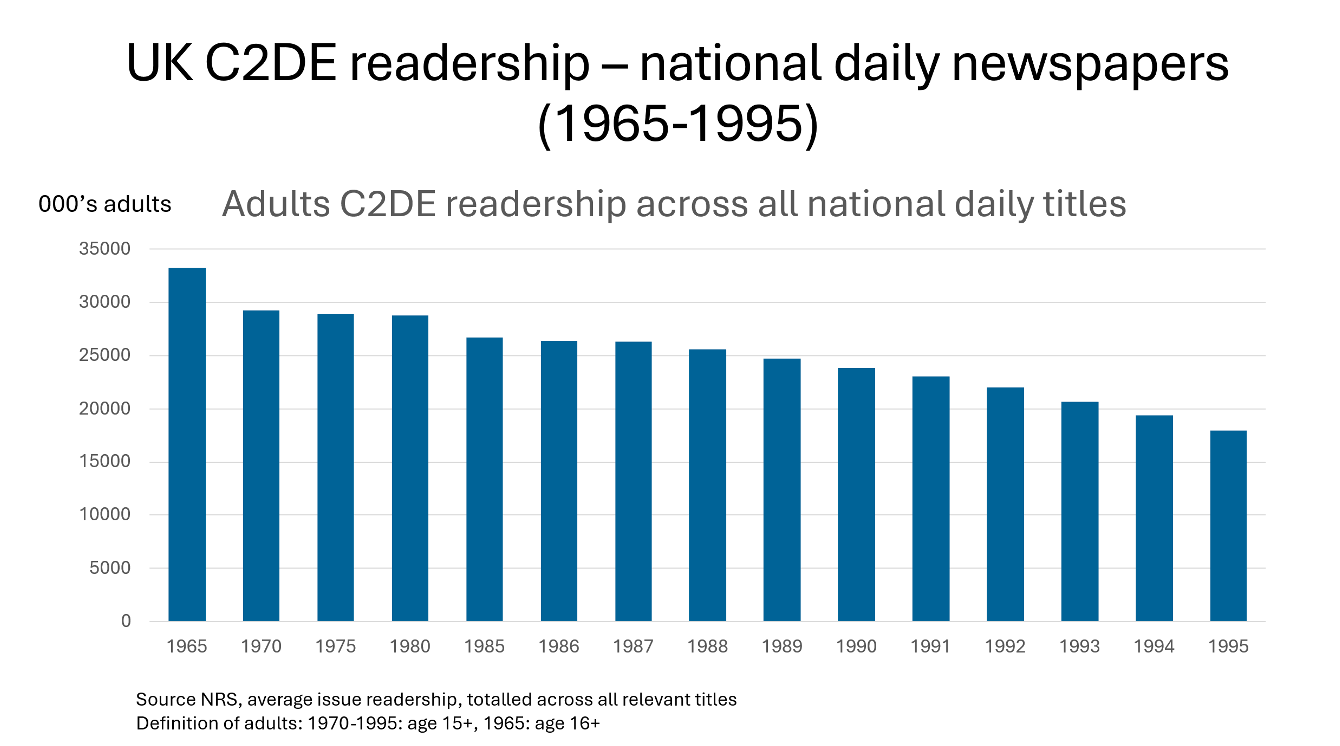
In fact readership of daily newspapers among middle class, professional households remained pretty stable. However, among C2DEs we can see a clear downward trend in daily newspaper readership.

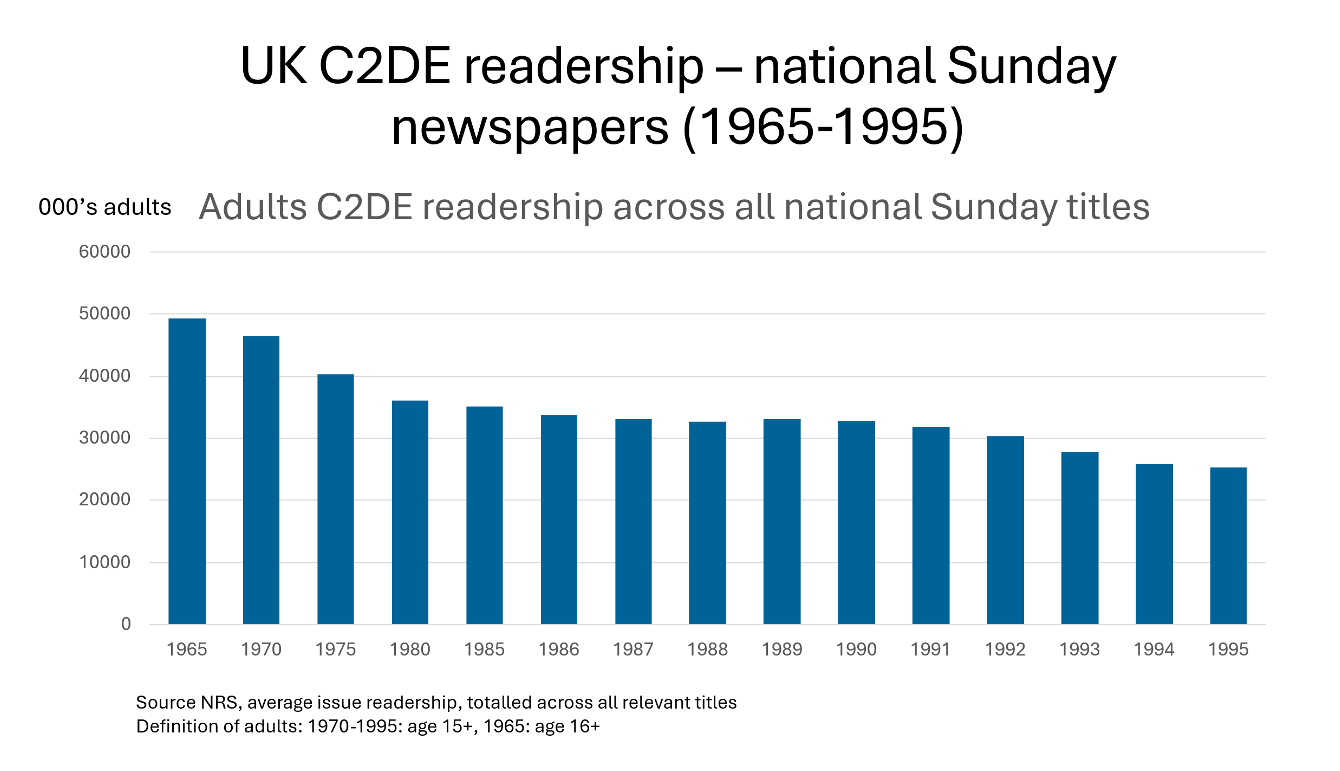
 For Sundays the decline among C2DE households was even greater and this clearly had an impact on popular titles targeting this group such as the Sunday Mirror or the People.
 A concerning indicator for all newspapers was readership among young people. From 1980 onwards the number of readers aged under 35 moved steadily downwards.
 For titles such as the Daily Express with a clear older readership the dwindling numbers of younger readers was a major concern.
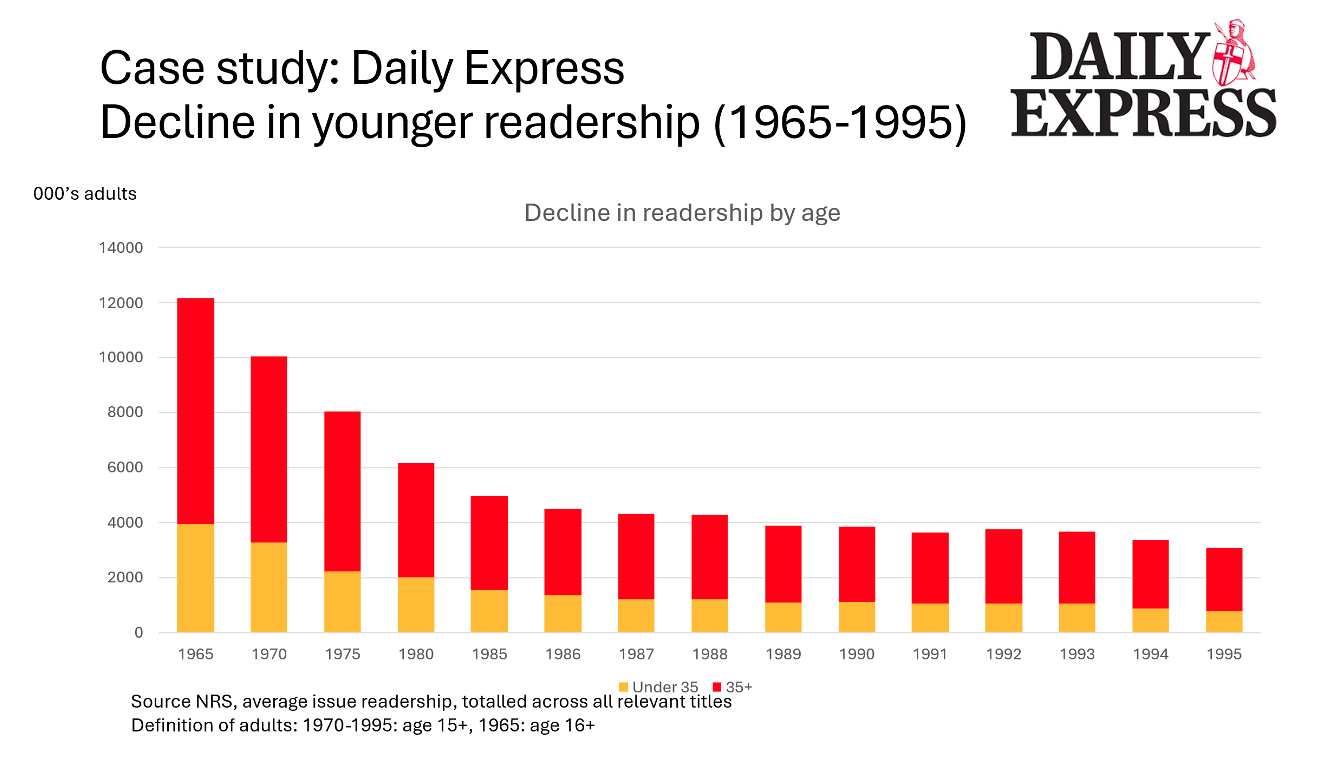
Readership was declining faster than the rest of the market, in part driven by the loss of younger readers. In 1965 readers aged under 35 made up about one third of the Daily Express readership; by 1995 this had dropped to just 25% of a much-reduced audience.
In contrast the Guardian, typically targeted at a ABC1, liberal minded audience retained younger readers over the same period. This put them in good stead for impending changes of the late 90s as digital media began to emerge as a serious competitor for time, attention and as a major news source.

As readership started to fall the newspaper groups took action. The market became highly competitive with various strategies to retain and attract readers. News Group who published the Times, Sunday Times, Sun and News of the World began an aggressive pricing strategy. Other groups focused on loyalty measures, free home delivery and rewards. But there was no doubt that the trend overall was downwards and that people generally had less time to devote to reading a newspaper.
5: The Digital Disruption – 1990s to present
The most significant shift, however, occurred with the advent of the internet in the mid-1990s and the subsequent acceleration of mobile technology and social media platforms. This period introduced new dynamics:
-
- Proliferation of sources: The internet offered an abundance of news sources, both from traditional publishers’ new websites and new digital-only outlets, intensifying competition.
- Shift in consumer preference: Audiences, particularly younger demographics, preferred the speed, convenience, and accessibility of online news.
- Decline in circulation: Print newspaper sales fell dramatically. National newspaper sales alone slumped by nearly two-thirds between 2000 and 2020. By 2014, no UK daily or Sunday newspaper had a print circulation exceeding two million copies. In recent years, year-on-year drops have often exceeded 10%.
- Advertising migration: A major financial blow came as advertising spend shifted online, where it could be targeted more effectively. Digital advertising revenue, though rising, has not been able to offset the significant losses from print advertising.
In summary:
-
- Access to the Internet grew from the mid 1990s with a second significant change as smartphones with mobile access via apps became widely available from the early 2010s.
- Decline in readership especially among the under 35s
- Newspapers developed strategies to adapt and protect their business – most notably managing their brand and content across print, online and mobile apps
- Measurement and advertising moved from newspaper only to news brands – covering print, online and mobile apps
From the mid 1990s onwards newspaper reading continued its decline. The main driver of this was an age-related demographic trend – the traditional audience for newspapers was, quite literally, dying off. Newspapers were no longer a fixture in the daily routine of younger consumers to the same extend as older people. There was greater competition for news delivery from different sources 24 hour news channels, online news. And more generally a greater amount of time was being spent on other media, increasingly digital media.
From the chart below, taken from the The Henley Centre’s 2003 Media Futures survey, it is also clear that at the end of the 20th century competition for leisure time and the growth in availability of other news and entertainment sources was contributing to a decline in the time people spent on reading newspapers. From 3.5 hours a week in the late 1980s to just 2.7 hours by 2003. This was only set to decrease further as Internet access became more widespread and smartphones became commonplace.

From the mid 1990s Internet access became more widespread, initially on PC’s at home and in the workplace but by 2010 smartphones were becoming more commonplace and a natural place to access news and information.
By 2008 around half of the population were accessing the Internet every day and the majority of British adults had been online within the last 12 months (Readership in the age of the Internet, Katherine Page Worldwide Readership Research Symposium 2009). As mobile phones became more commonplace so online media became the default for many seeking information and so displaced the role that printed newspapers had fulfilled in the past. This is clearly illustrated below, tracking the role of the Internet over the first two decades of the 21st Century.
 Mobile phones were a rarity in the mid 1990s with TGI reporting just 6% of British adults owning one in 1995. With the advent of smartphones in 2010 the ability to access news and entertainment online became even easier. By 2010 92% of adults had a mobile phone, many of which were smartphones. These days ownership is near universal at around 95% of the population (TGI).
The impact of this online competition is clear on print newspaper readership. From TGI we can see a steady decline in the weight of newspaper readership from the 1990s and the steepest decline after the advent of smartphones from 2012 onwards.
 The role of the printed newspaper as the primary means of information and news was on the decline. In the late 1980s almost one in five adults (18%) definitely agreed that “I rely on newspapers to keep me informed” but by 2022 this had dropped to just 7%. Clearly online news was a major driver here – as we saw earlier, at the turn of the 21st century, just 3% of British adults definitely agreed that “when I need information the first place I look is the Internet”; by 2022 this had risen significantly to 40%.
Again it was the 15-34 years olds who were losing the newspaper reading habit in the greatest number. In 1987 almost 7 in 10 had read at least 4 copies a week; by 2012 this had dropped to less than half. But it was really the advent of smartphones that led to the most significant decline. By 2017 41% of all 15-34 year olds did not read or look at any newspapers across a week. By 2022 this had risen to over half of this age group with only 3% having the equivalent of a daily readership habit.
 Newspapers saw the rise of online as a threat but also an opportunity. They were in a strong position to develop their brands online as trusted news sources. All of the newspaper groups invested heavily in their online presence, initially websites but increasingly in newspaper apps that could be readily accessed on the phone. According to TGI by 2022 just over half (53.3%) of adults read or downloaded newspaper article online and 27.5% had a national newspaper app on their phone.
Some newspaper sites attract significant audiences online. According to TGI Clickstream (2022 data) almost half of British adults (46%) had accessed dailymail.co.uk in the previous 4 weeks. Similarly, with a different offer and audience, the Guardian online measured an average of 42% adults visiting within the last 4 weeks. The printed titles remain but have adapted content and style to complement the online entities. So the newspaper is not yet dead but has evolved to a different product as consumers and technology changes.
6: Note on readership measurement and challenges
Much of this paper is based on survey research conducted among large, representative samples of the population. This type of large scale quantitative survey evolved across the 20th century. It required a strong infrastructure and considerable investment in order to provide reliable estimates of readership.
Before the Second World War this type of research was relatively rare and conducted on an occasional basis. By the 1950s the pressure of the commercial need to measure audiences accurately, combined with changes in technology and infrastructure enabled the first continuous surveys to take place.
The sorts of obstacles that researchers faced included:
-
-
- Computers were non-existent or rare. Therefore all data collection was manual using paper questionnaires, sometimes completed by the individual but more commonly by a professional interviewer who visited the home.
- Data processing and analysis was manual until early computers were developed for businesses in the middle of the century. Even when computers became more widespread there was a lack of computing power compared to the modern day. This limited the analysis that could be conducted on the data and a lag before results were released – typically weeks after data collection.
- There is a real challenge in asking questions in order to measure readership accurately. Researchers needed to carefully phrase and prompt respondents to avoid inaccurate recall, confusion between different titles and any overclaiming
- due to social bias.
- Our attitudes to demographic questions have changed over time – questions around age, occupation and education could be perceived as too personal for many.
- Reliable census information was needed in order to provide accurate samples of the population and to weight up to known population statistics.
- Consistency in measures. Until industry surveys such as the National Readership Survey (now PAMCO) were developed there were no consistent agreed ways in which to measure newspaper readership.
-
7: Differentiating newspaper titles – audience profiles
From their very beginnings newspaper titles were clearly differentiated in terms of their political leaning, outlook and audience. Each title has a very different audience profile to others in the market.
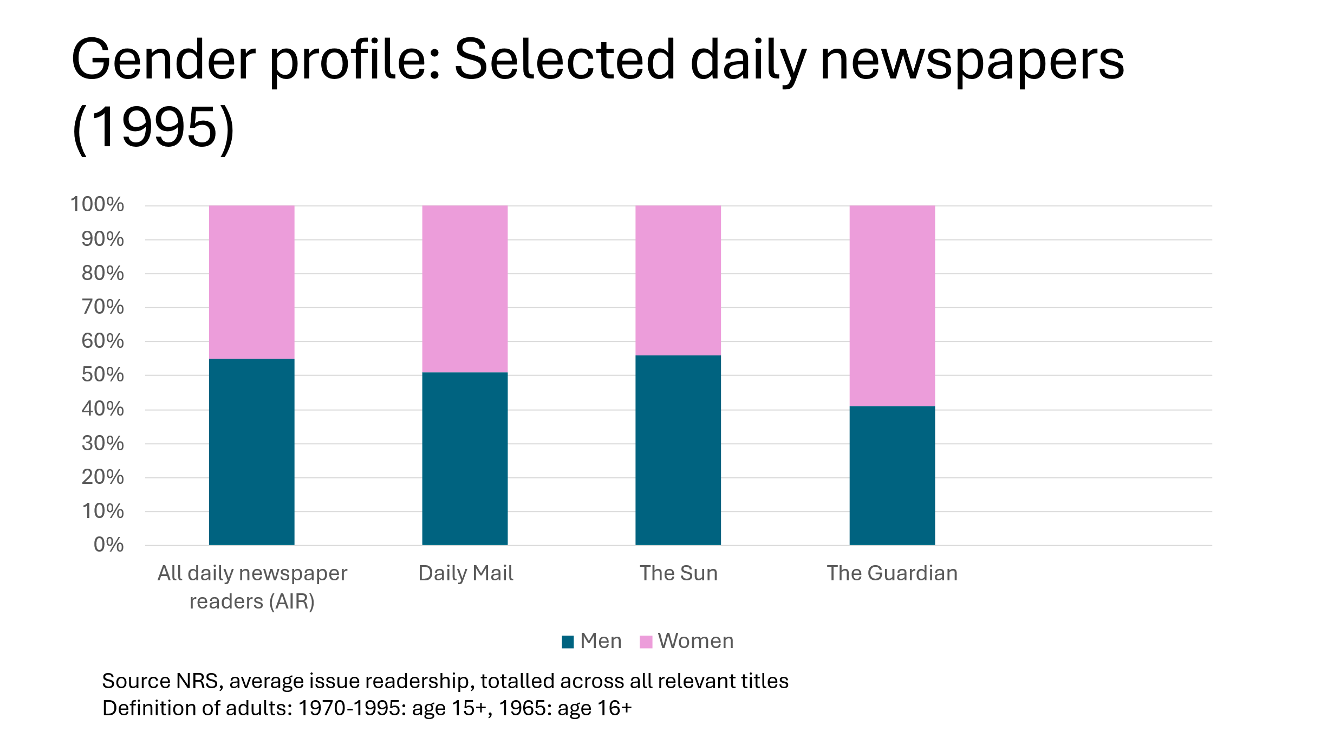
Here we look at audiences at the end of the 20th Century, in 1995. The Internet is just beginning to become available in British homes but the impact on newspaper titles is yet to be fully felt. Newspapers were clearly differentiated by political outlook, content and focus. They were some of the best targeted media of the 20th Century.
Typically newspaper readership had a male skew but this varied considerably by title.
 Similarly each title had a different appeal by age – the Telegraph and Express tended to have older audiences while a popular title such as the Sun had a strong appeal to young adults under 35. Over time, as digital media grew, all newspapers struggled to retain their appeal for the under 35s.
 Perhaps the most pronounced difference was by social grade with professional, upmarket households most clearly reading “quality” titles and the popular press having greater appeal to C2DEs.

8: Population estimates for the UK (for context)

9: Sources
All contained on the Archive of Market and Social Research unless stated.
-
- “Press Circulations Analysed” – the London Bureau, published in 1928
- IIPA Survey of Press Readership, 1939 *
- Adrian Bingham: Monitoring the Popular Press (2005)
- Hulton Readership Study (1956)
- Report – The Sunday Times and the Quality Press (1967)
- Education, social class and reading of newspapers and magazines, Mark Abrams, 1966
- 30 year Readership Patterns, Guy Consterdine. Within this report circulations as given by ABC average for Jan- Dec for each year given. Readership taken from National Readership Surveys.
- Circulations from ABC with 1910/1921 and 1930 from T.B. Browne’s Advertisers’ ABC **
- The Sunday Times and the Quality Press, Nov 1967
- The Changing Print Media Marketplace, Dawn Mitchell, Worldwide Readership Research Symposium V
- Readership in the age of the Internet, Katherine Page Worldwide Readership Research Symposium, 2009
- The Regional Press in the UK – Admap 1974-1975, edited by Brian Knox Peebles
- Media Futures, The Henley Centre
- UK Consumer Media Group (1988)
GB TGI analyses from 1987 to 2022
* Referenced in JWT report on press readership but unavailable on Archive.
** For reference – not directly available through the Archive
10: Lesson and independent research activity
Lesson and independent research activity:
A key aspect of the Media is Advertising – although your exam will relate to specific forms/titles it’s useful to have a general understanding of how advertising works. Here are some articles in the Archive which will give you an overall understanding:
• How do I use print advertising effectively? – Page 1 – Millward Brown – The AMSR Online Archive (2017)
• What makes an ad persuasive? – Page 1 – Millward Brown – The AMSR Online Archive (2015)
• How to make the best use of music in an ad – Page 1 – Millward Brown – The AMSR Online Archive (2014)
• Making the most of multimedia advertising – Page 1 – Millward Brown – The AMSR Online Archive (2017)
Magazines are known as a very good place to advertise for certain products – here’s an article by Amanda Claesens, an experienced media researcher, that draws on the Archive to explain why and how digital formats have continued to deliver, and gives you a more personal insight into magazine advertising.
Please do contact us if you have any specific areas that we could help with. We have many other reports which would be useful for coursework and independent study. We can also advise on how to conduct research. And remember that it’s helpful for all students to be able to demonstrate the use of archives and other sources in their work.
To find out more about how to access and search the archive, click here.
ACCESS THE ARCHIVE
