
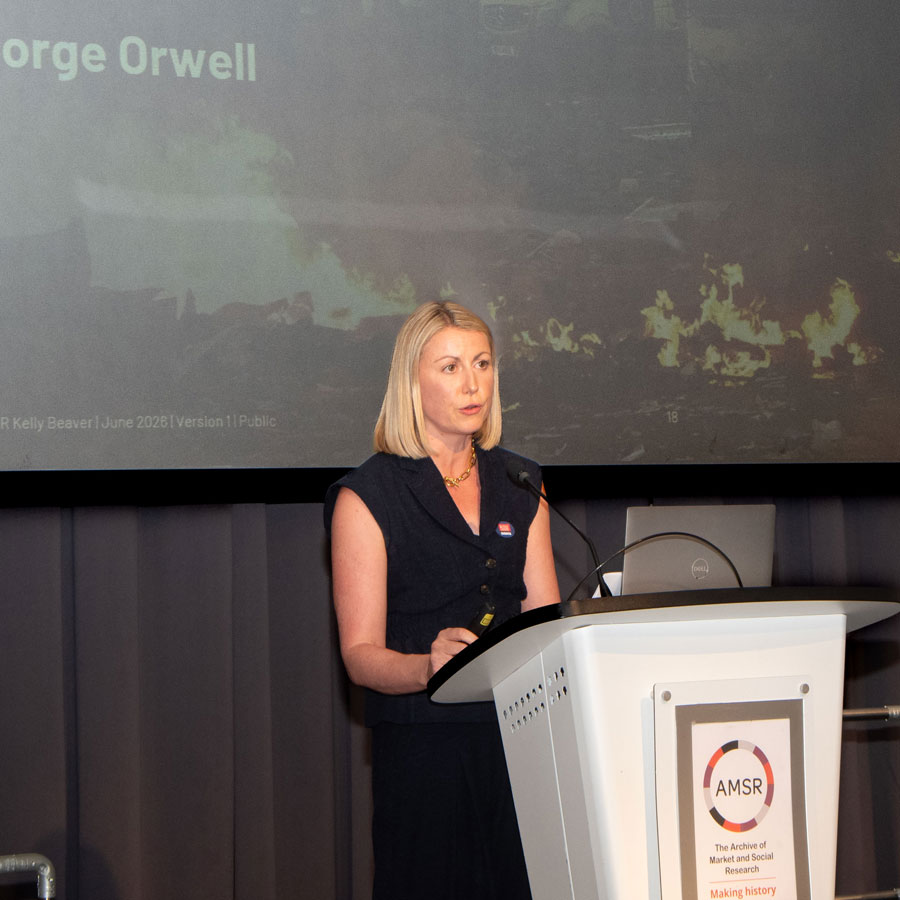
Kelly Beaver, CEO UK & Ireland of Ipsos, gave the keynote address to the AMSR’s Summer Event on 29th June 2026 on the theme “What is the point of the Archive in this modern world?“. This is the text of her speech.
Good evening everyone. It’s a pleasure to be here to talk about something I feel genuinely passionate about – the future of the Archive.
Now, I’ll admit – the title of my talk sounds deliberately provocative. What’s the point of the Archive in this modern world? It’s the kind of question that might make some of you slightly nervous. But I want to tackle it head-on, so let me start by posing some questions to you all.
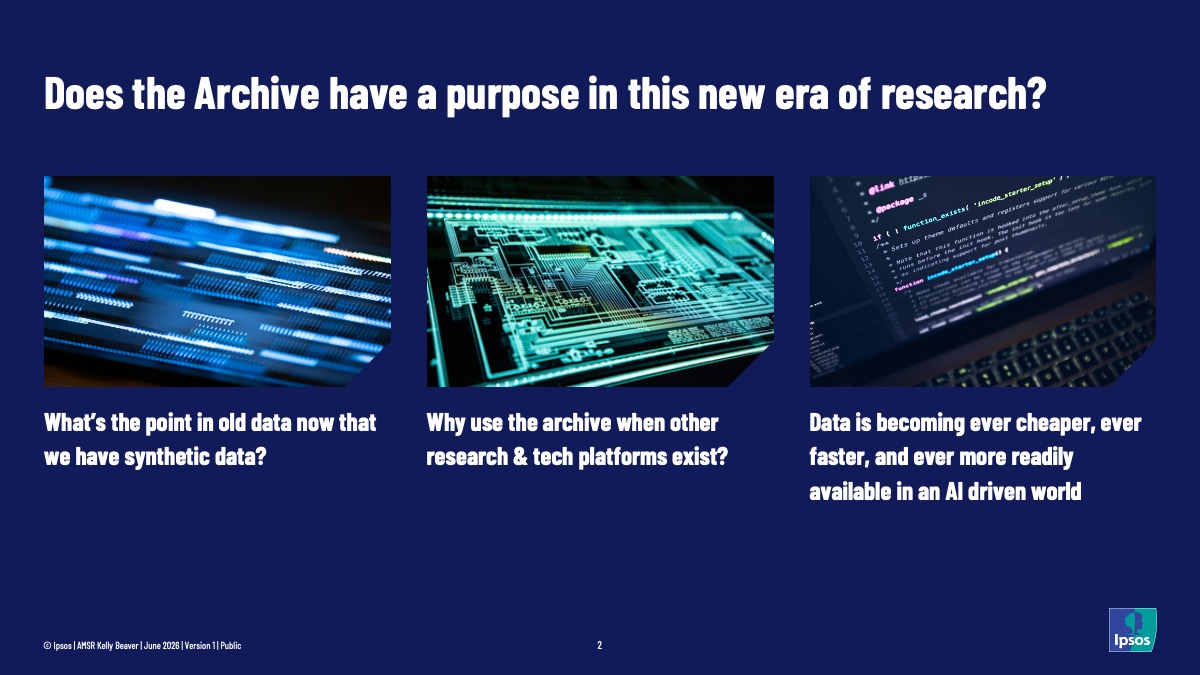
First, what’s the point of old data now that we have synthetic data? AI can generate consumer responses, simulate attitudes, create entire datasets from scratch.
Second, why use the Archive when there are so many other research platforms and tech solutions available? We have real-time dashboards, social listening, behavioural data streaming in constantly.
And third: data is becoming ever cheaper, ever faster, ever more readily available in this AI-driven world. Surely that makes historical archives redundant?
These are fair questions. And I want to give you three compelling reasons why the answer to all of them is that the Archive has never been more important than it is right now.
Here’s my first reason: It preserves truth in a synthetic data world and prevents “Habsburg AI”
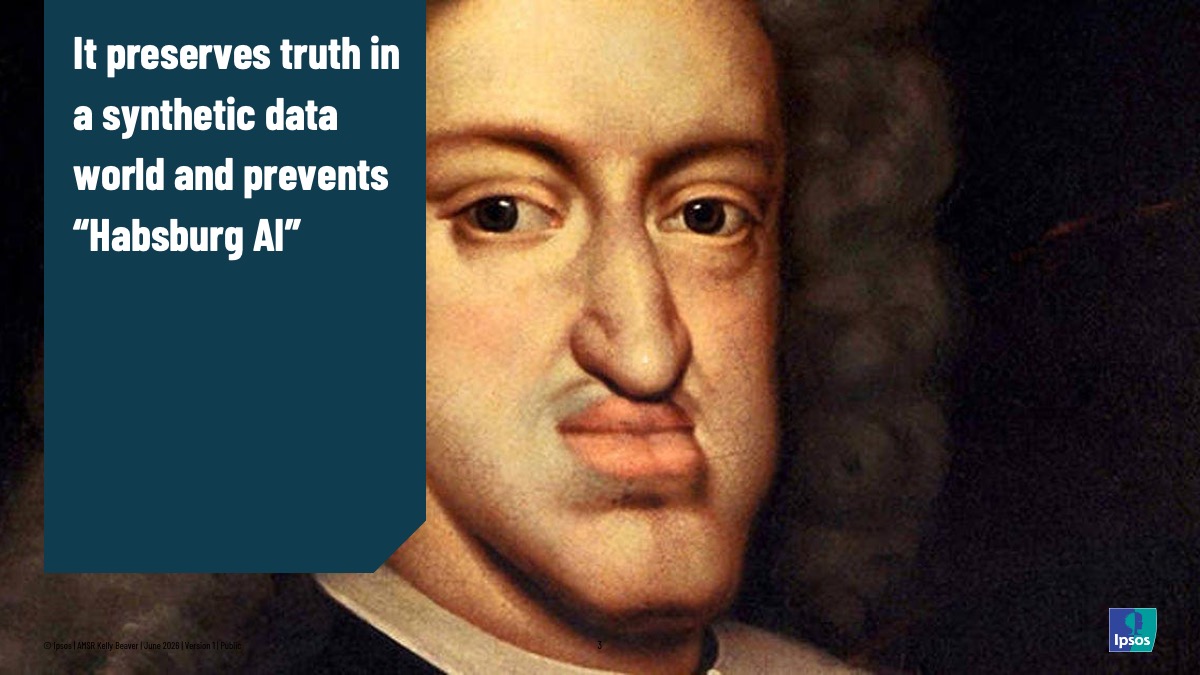
Now, some of you might be wondering what on earth “Habsburg AI” means. It’s a term that’s emerged in AI research circles, and it refers to something rather alarming.
You’ll remember the Habsburg dynasty – European royalty who intermarried so extensively that they eventually produced offspring with serious genetic defects. The famous “Habsburg jaw” being the most visible example.
Well, we’re starting to see the digital equivalent. AI models are increasingly being trained on content that was itself generated by AI. And when AI trains on AI-generated content, the outputs start to degrade. They become distorted. They lose connection with reality.
This is why archives of real human responses – genuine attitudes, actual behaviours recorded at the time – become not just valuable, but essential. They’re the anchor of reality in an increasingly synthetic information ecosystem.
The Archive provides what we might call “ground truth.” When someone asks, “Did consumers really think that? Did that trend actually happen?” – the Archive can answer definitively, with verified evidence.
My second reason: the Archive safeguards against hallucinated history.
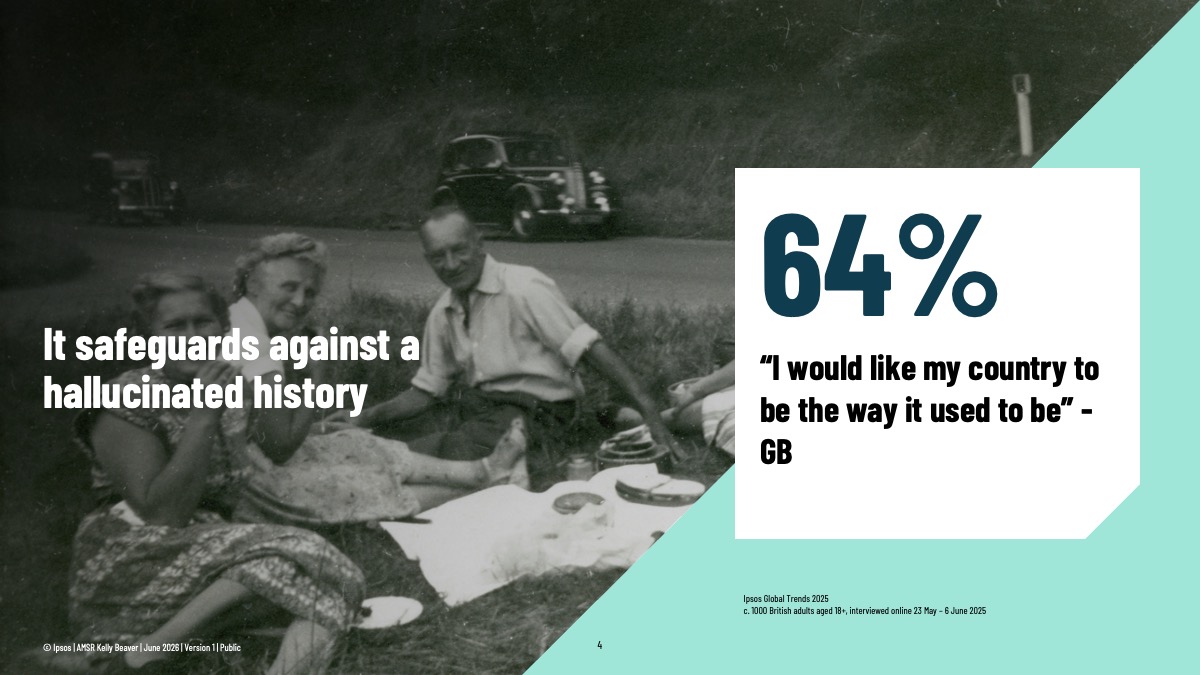
Our latest global trends study shows that 64% of British adults say they’d like their country to be the way it used to be. But here’s the question: the way it actually was? Or the way we imagine it was?
Nostalgia is powerful. And AI systems, trained on romanticised narratives and selective memories, can generate very plausible but entirely fictional accounts of the past.
Let me give you a concrete example. There’s a prevailing narrative about the Thatcher era – Cold War leadership, partnership with Reagan, victory over socialism, the fall of the Berlin Wall. The grand sweep of history.
But what did the British public actually care about at the time? The Archive tells us: it was overwhelmingly domestic concerns. Not the grand geopolitical narrative at all.
The same is true of the 1960s. Harold Wilson kept Britain out of Vietnam – but was the public engaged in great foreign policy debates? No. They were worried about the cost of living. Sound familiar?
Or take immigration. There’s often an assumption that public concern about immigration is a recent phenomenon. But the Archive shows that public attitudes on immigration were remarkably strong in the 1960s. That’s not a comfortable truth for some narratives, but it is the truth.
Without archives of real, verified data, we lose the ability to fact-check the past. We become vulnerable to whatever story sounds most plausible – or most convenient. The Archive becomes our fact-checking layer against machine-generated narratives about who we were and what we believed.
My third reason: the Archive prevents what I call ‘data vanillafication.’
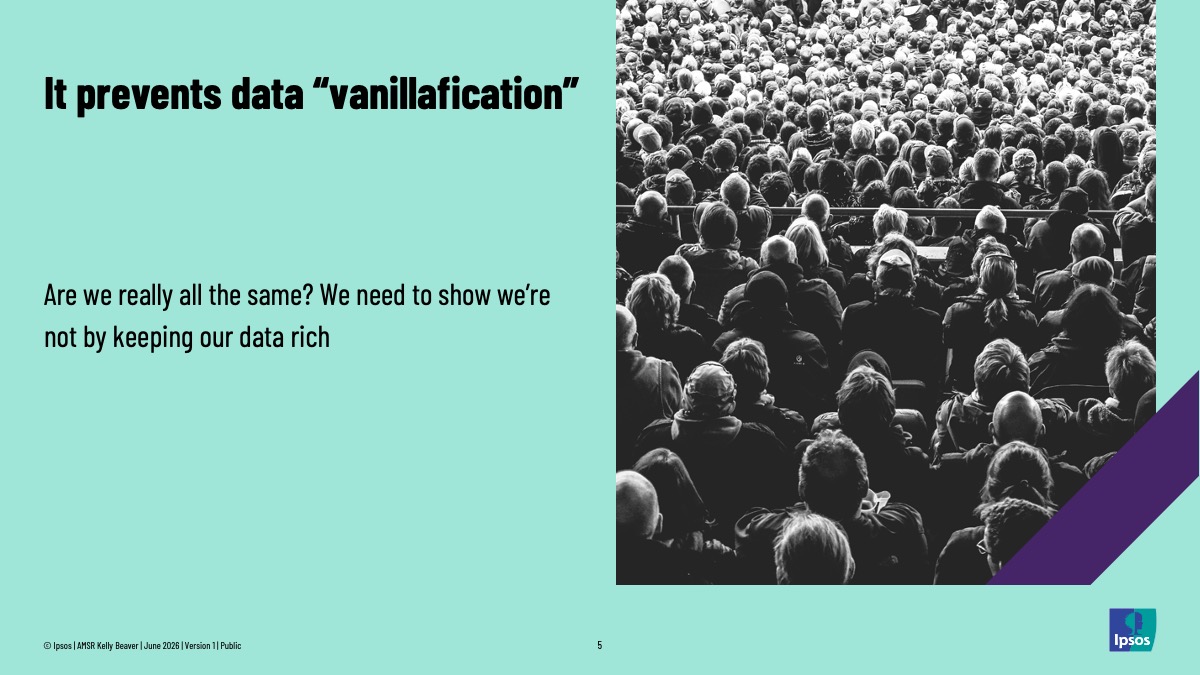
Here’s the risk. When AI systems are trained on similar internet-scale sources, they start to converge. Perspectives flatten out. The rich diversity of human experience gets smoothed into a kind of algorithmic average.
But real people aren’t averages. And the Archive captures that beautiful, messy complexity. Let me share some examples. The Archive contains qualitative research that lets us track how attitudes to masculinity changed through the 70s and 80s – through grooming products and deodorant studies of all things! We can see how women’s attitudes to ageing evolved through skincare research. How our relationship with cleaning and domesticity shifted through studies of household products.
And sometimes, what’s most revealing is what’s not there. I was struck by research into financial services in the 1970s. You’d expect that after the Equal Pay Act and Sex Discrimination Act, banks would be busily researching what women wanted. Not one bit of it. Women are barely mentioned throughout the entire decade. That silence tells us something profound about the real pace of social change. Here’s another nugget: in 1974, researchers struggled to find single women who had recently bought a new car. Why? Because single women couldn’t take out loans in their own name. Young women today find that absolutely astonishing – and rightly so.
This is the texture of real human experience that AI cannot fabricate and must not be allowed to flatten. We’ve seen this as a key sentiment among our clients recently is the fear of bland, mediocre, or homogeneous insights produced because AI models are trained on average data.
And this quote from George Orwell feels particularly pertinent right now.
“In a time of deceit, telling the truth is a revolutionary act” – George Orwell

In an age where AI can generate plausible-sounding history, convincing-looking data, and entirely synthetic public opinion… maintaining an independent, verified record of what people actually thought and felt becomes genuinely revolutionary – and prevent falsehoods from whipping up public frenzy.
The research pioneers who built this industry – people like Sir Robert Worcester and Liz Nelson – understood something fundamental: our job is to provide a true understanding of society, with integrity and skill. Not to tell clients what they want to hear. Not to generate convenient narratives. But to capture reality. In a democratic society, that independent record of how it really was – what people genuinely cared about, what they actually believed – becomes increasingly precious. It’s not just about market research. It’s about preserving democratic memory itself.
Now, I’ve made the case for why the Archive matters more than ever. But I’m not going to pretend it can simply stay as it is.
The Archive must adapt to continue thriving.
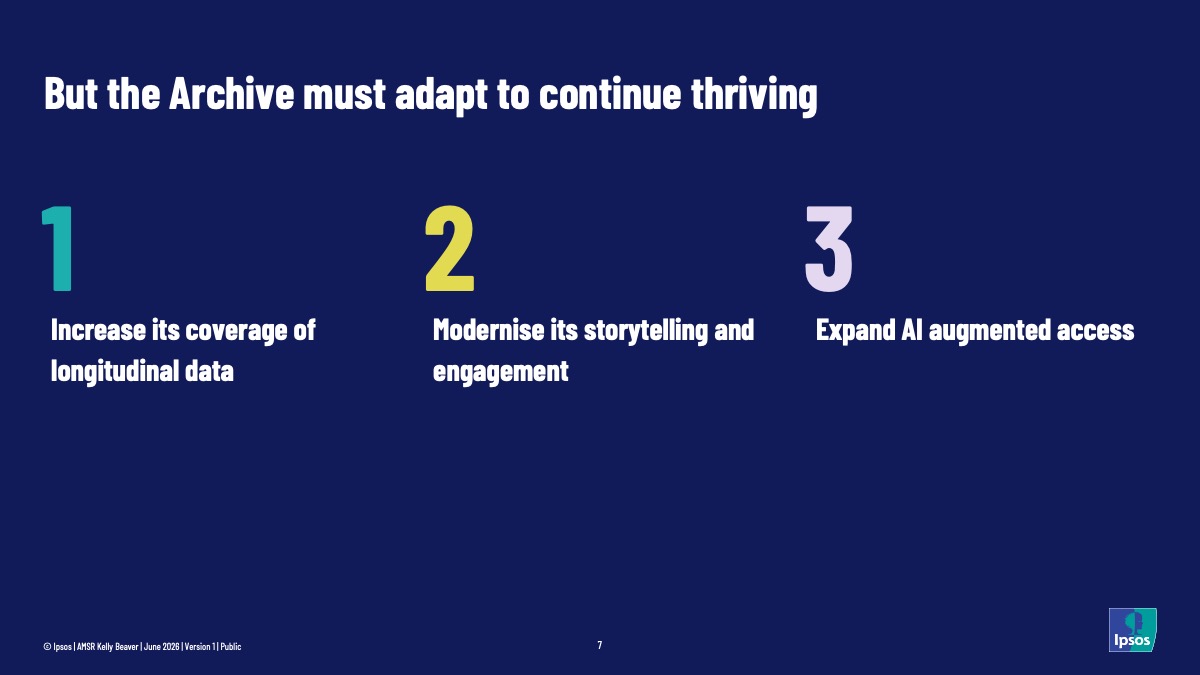
Firstly, it needs to increase its coverage of longitudinal data. This is one of the archive’s great strengths – but currently, it’s patchy and comes from incomplete sources. We need more of it, protected, and preserved.
Secondly, modernise its storytelling and engagement. The “Stories from the Archive” essays are a strong start, but we need to go further. Storytelling turns raw data into shareable content: short-form video, podcasts, interactive timelines showing how attitudes evolved decade by decade. When topics trend – cost of living, housing, political polling – curated collections can attract media attention and new audiences.
And lastly, it must expand AI-augmented access. This is where the opportunity truly lies. Semantic search – letting users query by concept rather than exact keywords. AI-assisted summarisation that surfaces key findings from lengthy reports. Imagine asking: “What did British consumers think about home ownership in the 1980s?” and getting a synthesised response drawing on decades of research. That transforms the Archive from passive storage into an active insight engine – accessible to younger researchers who’ve never browsed a traditional catalogue.
Done well, the Archive won’t just be a repository. It will be an active participant in how our industry – and our society – learns from its own past.
Kelly Beaver, CEO UK & Ireland, Ipsos
Date posted: 6th July 2026