

Ben Clements
Ben Clements is Associate Professor in Politics, in the School of History, Politics and International Relations. University of Leicester. His research interests include British public opinion towards foreign and defence policy in the post-war period. He has published widely on this topic, including British Public Opinion on Foreign and Defence Policy: 1945-2017 (Routledge, 2019)

(image credit: https://share.google/nCDbqrKqFfiVLqcDx)
After 13 years of Conservative government from 1951-64, which included debate over Britain’s role in an integrating Western Europe, the ongoing process of decolonisation and the USA’s increasing involvement in Vietnam, Labour was returned to office at the 1964 general election. It governed with a very small majority before securing a much stronger position at the 1966 election. The Labour governments, led by Harold Wilson, inherited a complex and shifting foreign policy agenda and had to govern, until it left office in 1970, within the context of Britain’s increasingly constrained global role and economy difficulties.
In contemporary politics, opinion polling has gauged how the public views the parties on defence and security policy and Keir Starmer’s handling of international issues, such as relations with the USA and the war with Iran. Discussion of Starmer’s relations with President Trump have made historical parallels with the premiership of Harold Wilson, who faced the contrasting pressures of US demands for British military participation in the Vietnam War from President Johnson and significant opposition to the war in the Labour Party and the wider country.
NOP polling reports from the Archive of Market and Social Research (AMSR) shed light on how the public perceived the Wilson governments on specific international issues and in managing the area of foreign policy.
Table 1 shows public opinion in response to several questions in NOP polling asking about the Labour government and the Vietnam War. In September 1965, 33% approved of the government’s policy towards Vietnam and just 18% took the opposite view. Perhaps reflecting its lower prominence in public awareness at this stage, 49% were unsure. In December 1965, 37% backed the government’s support for American policy in Vietnam, but the question’s reference to the US elicited much more disapproval, at 33%; the proportion unsure was 31%. In July 1966, the public was more evenly divided in terms of the merits of the government’s approach: 42% said it should back the US and 45% disagreed (the proportion unsure was 13%). Two polls conducted in 1967 showed increased levels of disapproval, rising to 49% in February and, even further, to 67% in November. In November, just 21% expressed approval of the government’s backing for the US, down from 36% in February. In February 1968, a majority (59%) opposed the government’s policy of supporting the US, with just 27% backing it. On the issue of troop commitments, in July 1966, a majority (65%) were opposed and 23% held the opposite view. This was one area where the public’s widespread opposition aligned with the steadfast refusal of the Wilson government to send British forces.
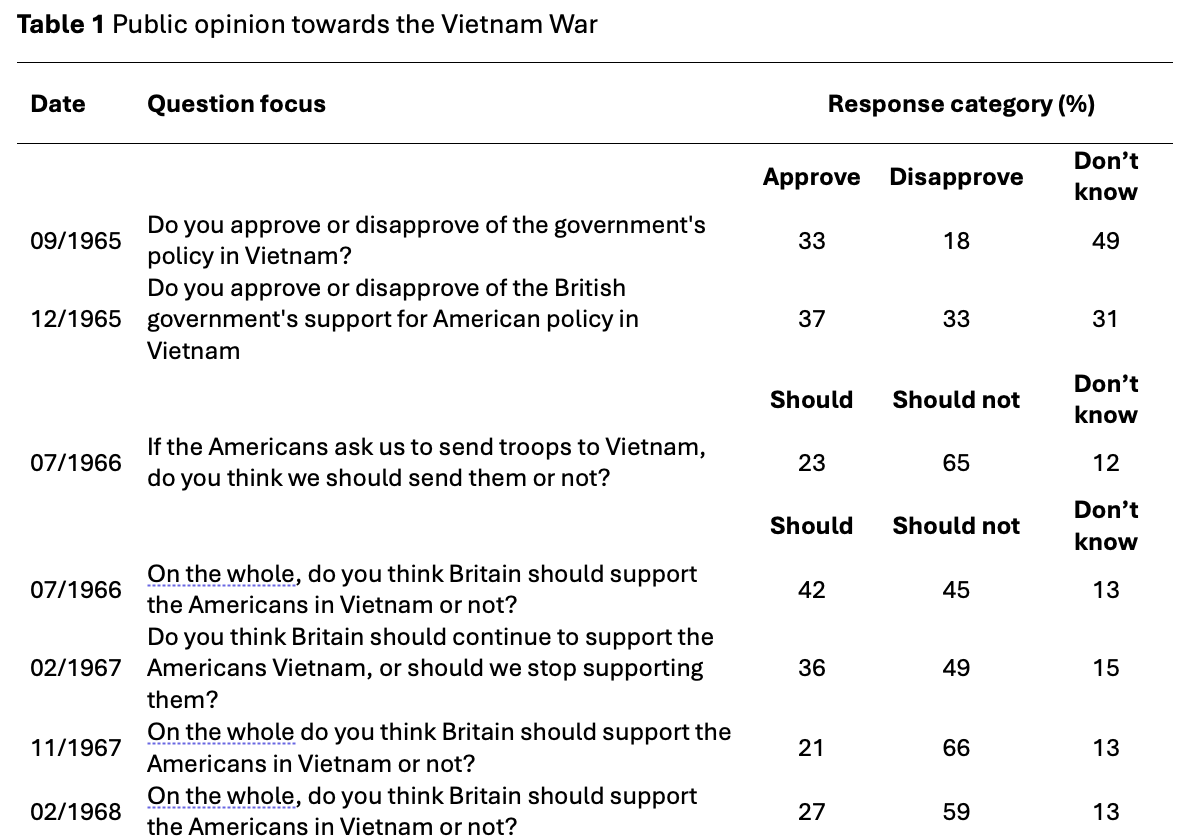
Source: Clements 2021
The Vietnam War is a good example of polling on a foreign policy issue where there were strong views – inside and outside parliament – for or against the USA’s policies and the approach taken by the Labour government. NOP polling also featured questions probing the parties and leaders’ competence in managing foreign policy. NOP polling in Table 2 shows that the Conservative leader from 1963-5 (and prime minister from 1963-64), Alec Douglas-Home was rated more favourably on managing foreign affairs than was Wilson in 1964-5, but evaluation were more divided over Wilson and Edward Heath (Douglas-Home’s successor) in 1967.
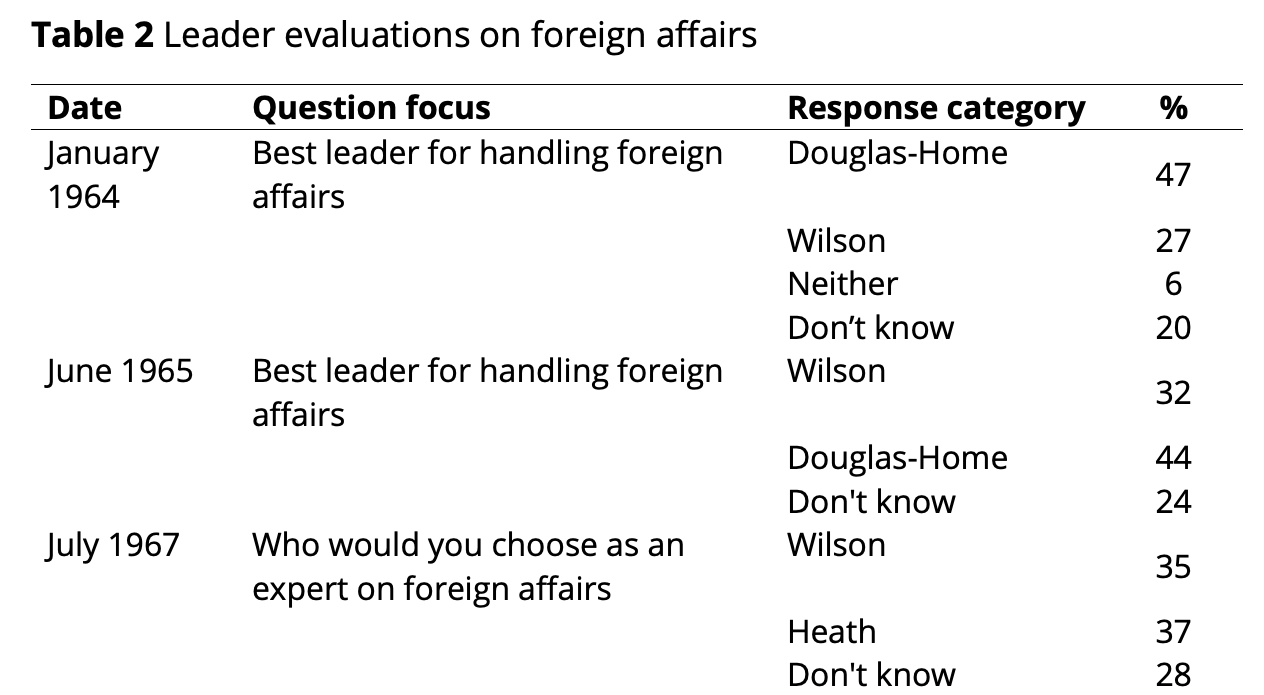
Source: NOP opinion poll reports from AMSR
NOP polls also asked the public about which political party was best able to handle foreign affairs. The results are shown in Table 3. A similar pattern is evident across several of the years when the Labour Party was in office managing Britain’s foreign affairs. In 1964, 1966 and 1967, the Conservative Party was consistently seen as the best party on foreign affairs, between 42-45% chose it compared a range of 21-34% for Labour.
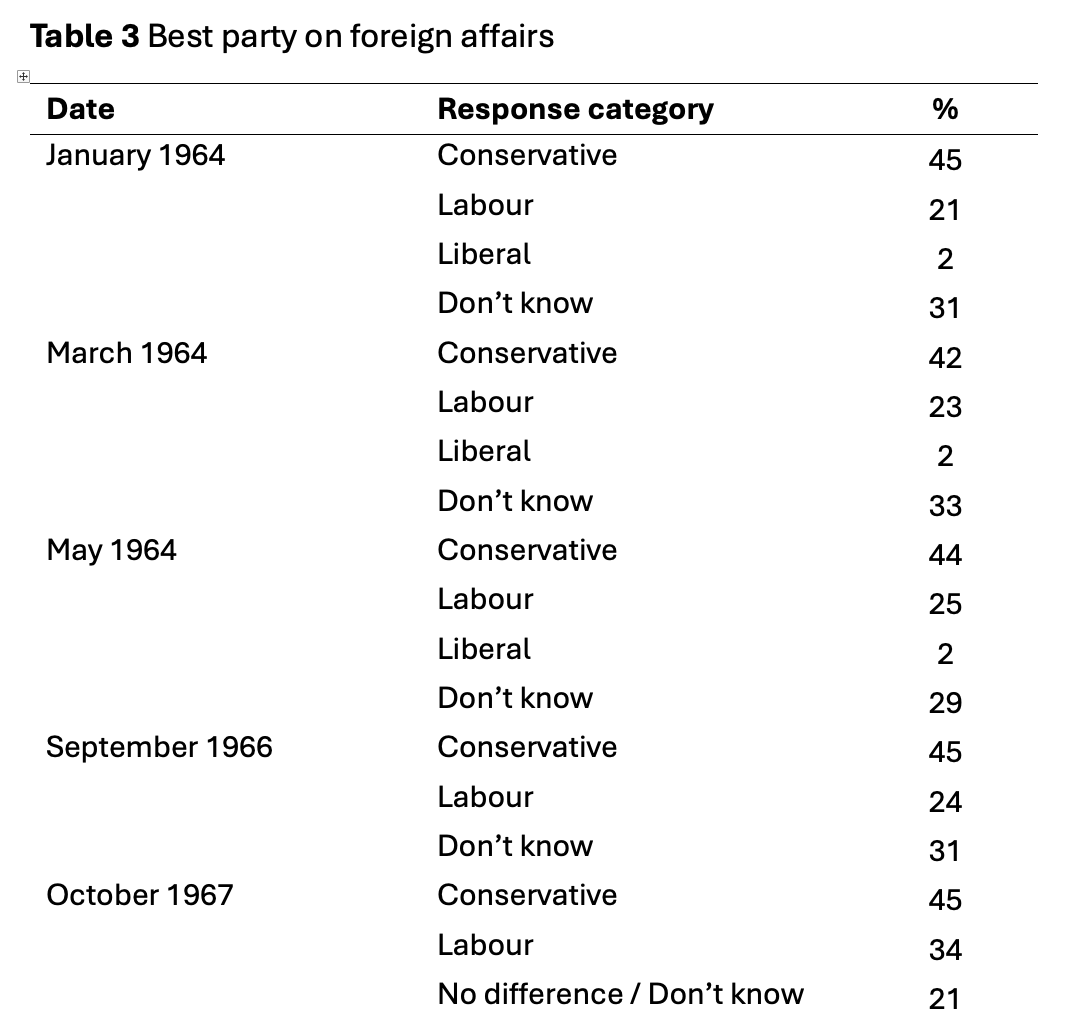
Source: NOP opinion poll reports from AMSR
The 1960s were a period of increasing difficulties for Britain as a country with global interests and commitments, in terms of the misalignment between aims and resources, particularly as the country encountered economic difficulties at home and abroad. The growing constraints on Britain’s international role that faced politicians and diplomats in the decade is perhaps reflected in questions that asked about the country’s prestige overseas. As Table 4 shows, a plurality of opinion in November 1966 thought that Britain’s prestige was less than it had been under the Labour government, while a majority or plurality expressed dissatisfaction with the maintenance of Britain’s prestige abroad on several occasions in 1968-9.
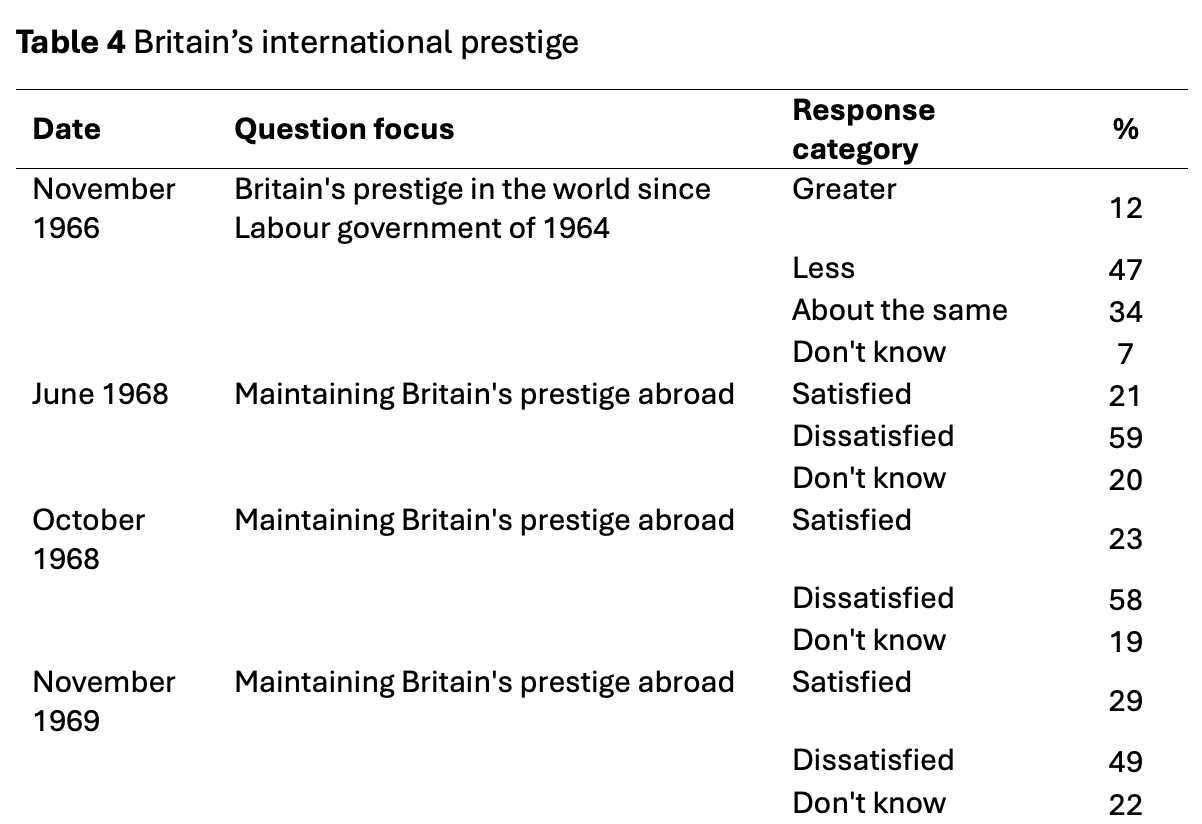
Source: NOP opinion poll reports from AMSR
Earlier, in January 1965, 60% of the public said that Britain’s power and prestige had declined in the period since World War Two, while 21% thought it had actually increased. In December 1966, the public’s sense of Britain’s weakened role internationally was also evident when if the country was a ‘third-rate power’: 52% agreed with this assessment and 39% did not. In the same opinion poll, a majority (64%) agreed that people overseas did not given Britain as much attention as they used to, with 23% disagreeing. Asked in December 1969 what they wished most for the country in the 1970s, 8% chose ‘To be a world power again/Increase our prestige’, which ranked behind three other options (in ascending order: ‘Peace’: 11%; ‘Economic situation improved/Debts paid off/More exports’ :14%; and ‘Prosperity/Change for the better’: 20%)
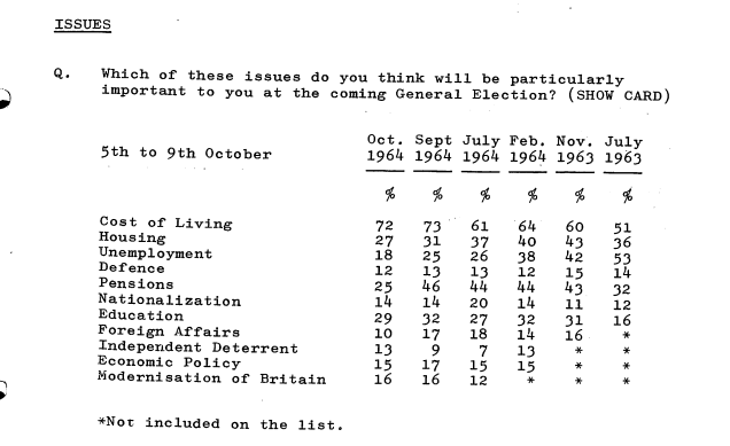
While the 1960s were a time of instability for Britin’s global commitments, tensions in US-UK relations and increasing debate at home over membership of the Common Market, for most people it was domestic issues that were seen as consequential for how they would vote and also seen as most significant nationally, at general elections. As shown below, NOP polling before the October 1964 election highlights the particular importance of the economic situation for party choice, the cost of living always ranked as the number one issue but also increasing in prominence over time. Amongst the other issues, there is some mention of defence, foreign affairs and the nuclear deterrent.
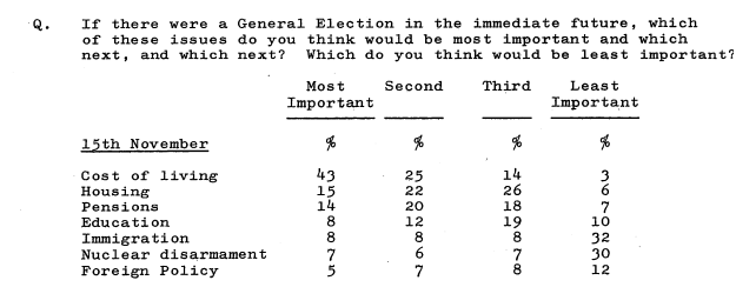
In November 1965, asked about issue importance if there was an upcoming general election, we can see that nuclear disarmament and foreign policy were particularly likely to be rated as the least important issue when asked to rank a series of them. Most important was the cost of living.
Source: https://amsr.contentdm.oclc.org/digital/collection/NOP_Reports/id/1875/rec/6
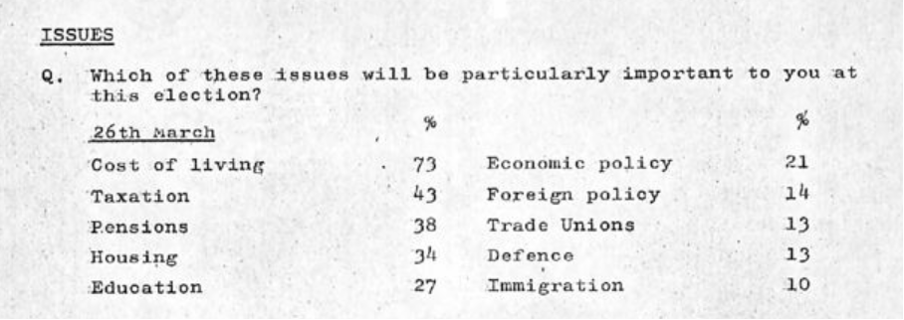
In advance of the March 1966 general election, the cost of living was again ranked as a particularly important issue personally by 73%, well ahead of all other issues, including foreign policy (14%) and defence (13%).
Source: https://amsr.contentdm.oclc.org/digital/collection/NOP_Reports/id/2161/rec/49
During the 1960s, then, the economic situation – specifically, the cost of living – was the most widely-mentioned issue in terms of relevance for general election voting. Foreign Policy was just not critical to the general public.
Dr Ben Clements, University of Leicester
Clements, B. (2021), ‘British Public Opinion Towards the Vietnam War and UK-US Relations During the 1964-70 Labour Governments’, International History Review, 43, pp. 736-60. https://doi.org/10.1080/07075332.2020.1828140.
Ellis, S. (2020), ‘British public opinion and the Vietnam war’, Journal of Transatlantic Studies, 18, pp. 314-32. https://doi.org/10.1057/s42738-020-00051-0.
Vickers, R. (2008), ‘Harold Wilson, the British Labour Party, and the War in Vietnam’, Journal of Cold War Studies, 10, pp. 41-70. https://muse.jhu.edu/article/237151.
Opinion poll resources
For the 1960s and for other periods of time, polling asking about foreign affairs can be located by searching the individual collections on the AMSR website, in particular: MORI British Public Opinion MORI Reports, Opinion Poll Reports and NOP Reports.
Data on foreign affairs from Gallup polling in the post-war period can be accessed via the ‘Social and Political Change in Britain (1945-1991)’ project, and from the book by King and Wybrow (2001).
Up-to-date polling on Britain and foreign policy can be searching the ‘Politics and current affairs’ section of the YouGov website, and by searching the website of Ipsos MORI.