

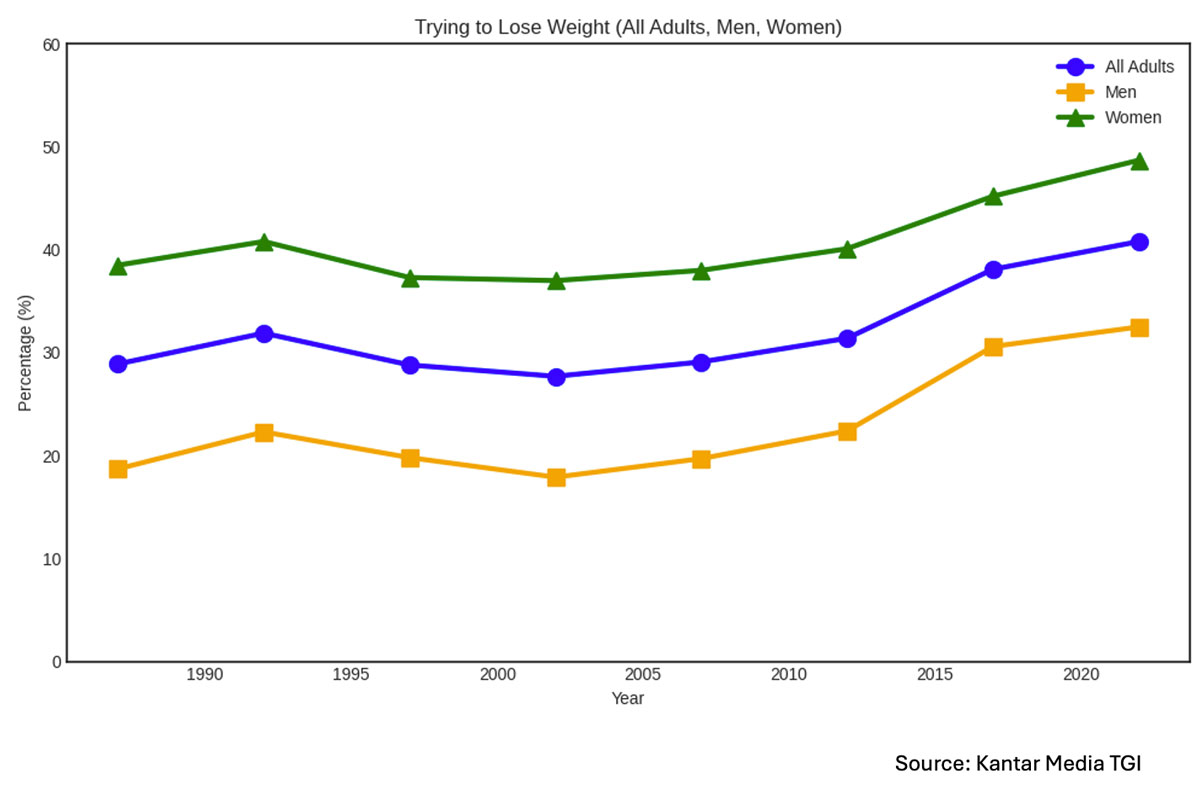
If you trace the long arc of British dieting from the late 1980s to the 2020s, the first thing you notice is that the dieting never stopped. The TGI chart of Trying to Lose Weight, 1987–2022, shows a steady, relentless rise. By 2022 about 40% of UK adults are trying to lose weight at any given moment. Dieting has become a permanent background condition of British life.
Women have always been more likely to diet — heading towards the 50% mark by 2022 — but for men the figure has gone from one in five to almost one in three. Public health obesity statistics show that men actually have higher obesity rates than women, and the gap has widened over time, but nevertheless lower proportions of men try to lose weight.
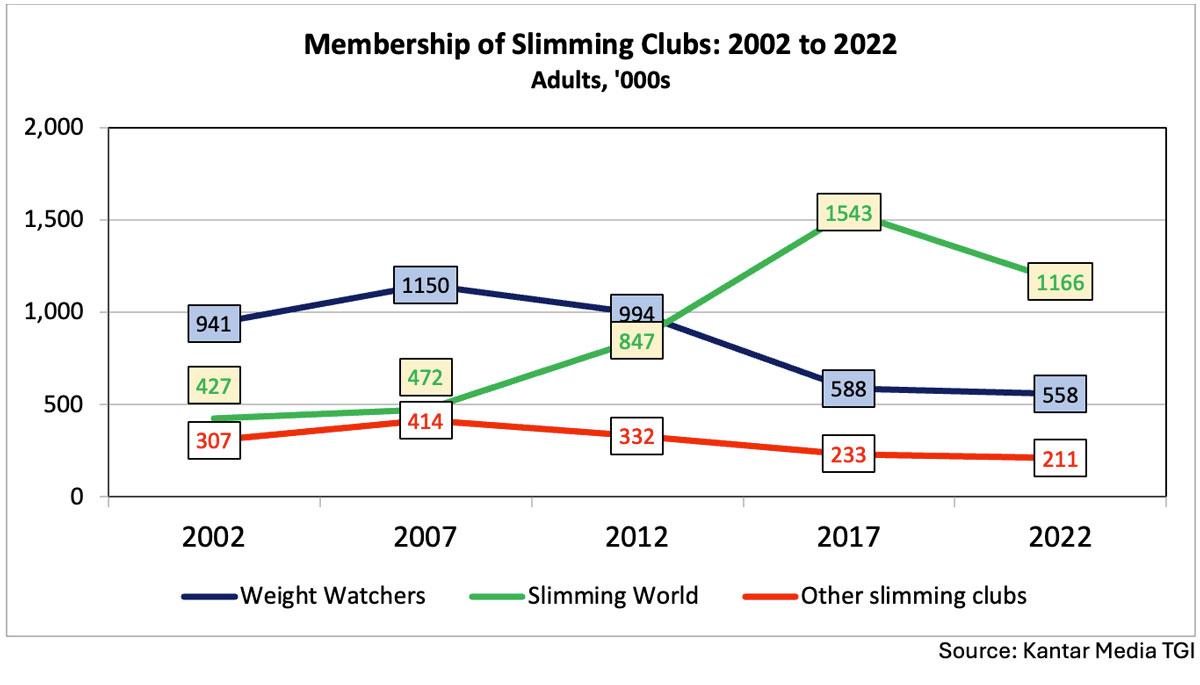
But while dieting has become so prevalent, the institutions that once organised it have quietly faded away. Weight Watchers — the brand that defined British slimming culture for decades — peaked in the mid‑2000s and then began a long, steady decline. From just under one million in the 1990s, Weight Watchers membership rises gently until around 2007, and then halves by 2022. In the USA, WW has recently filed for bankruptcy, and Heinz has pulled out of making WW products such as baked beans and frozen ready meals.
Slimming World, by contrast, with a slightly less prescriptive approach, grows through the 2000s and overtakes Weight Watchers after 2012. Throughout the 2010s, Slimming World is repeatedly described in the press as “the UK’s largest slimming club,” while Weight Watchers closes meetings, restructures its UK operations, and shifts toward digital subscriptions. But even Slimming World peaks in 2017 and softens thereafter, and is currently (2025/26) undertaking a major programme overhaul, strategically shifting towards more flexible, psychologically supportive, and nutritionally modern weight‑management approaches. “Other clubs” — the independents, the local groups, the one‑woman operations — fade steadily downwards.
The paradox is stark: dieting rises, obesity rises, fitness culture rises — but slimming clubs fall.
Part of the explanation is cultural. The old Weight Watchers rituals — the weigh‑in queue, the clapping, the laminated charts, the church‑hall camaraderie — belong to a more deferential era. They were built for a world where people accepted external authority and public accountability. Today’s dieters prefer privacy, autonomy, and self‑tracking. The smartphone replaced the group leader. The calorie‑tracking app replaced the food diary. The algorithm replaced the applause.
Part of it is behavioural. The PureGym national fitness report shows a surge in gym usage and exercise aspiration, especially among younger adults. Nearly half of adults now exercise regularly, and three‑quarters say they aspire to be fit. The gym — not the slimming club — has become the modern site of weight management. The cultural energy has shifted from “losing weight” to “getting fit,” from discipline to optimisation, from shame to self‑care.
And, of course, more recently, a good part of the explanation is pharmaceutical. From 2021 onwards, the arrival of GLP‑1 weight‑loss drugs — first as diabetes treatments, then as cultural phenomena — redrew the landscape. The weekly injection replaced the weekly weigh‑in. Weight Watchers has tried to pivot, rebranding itself as a “weight‑health platform” and acquiring telehealth providers. But the decline began long before the syringes arrived. The slimming‑club model was already losing relevance. Britain kept dieting — more than ever — but it stopped doing it in groups.
The two charts tell the story: the line for “Trying to Lose Weight” rises steadily. The lines for Weight Watchers, Slimming World, and “Other Clubs” rise briefly, then fall away. The behaviour survives. The institutions do not.
Whatever happened to Weight Watchers? Nothing dramatic. No collapse. No scandal. It is simply slipping out of the centre of British dieting life — gently, gradually, and almost without anyone noticing — while the country’s weight‑loss ambitions marches on without it.
Source:
TGI (Target Group Index) is a continuous survey which has been carried out in Great Britain since 1969, based on 25,000 adults per annum, who provide information on their use of all major products, brands and services. Media exposure, attitudinal and demographic data are also included. Kantar, who own and operate TGI, have made major donations of data to AMSR. To explore the TGI archive within AMSR, click here:
Target Group Index – The AMSR Online Archive (oclc.org)
All data copyright © Kantar Media UK Limited 2026. All use of TGI data is subject to Kantar Media UK Limited’s terms and conditions.
Contributed by: Phyllis Macfarlane, Geoff Wicken and Jenny Wedderkop, with help from CoPilot.
Date posted: 18th May 2026
Photo: iQuoncept/Shutterstock.com