
A Short History of Avon — and the World That Made the Avon Lady
Avon began in the late 19th century as the California Perfume Company, but the version Britain remembers — the Avon Lady — really took shape after the Second World War. By the 1950s and 60s, Avon had perfected a model that was both commercial and social: women selling beauty products door to door, often to other women like themselves, in a world where female economic independence was still tightly constrained.
The1950’s and 60’s: Avon Advertising: “Ding Dong — Avon Calling!”
No account of the Avon Lady is complete without her most famous line. Avon’s “Ding Dong — Avon Calling!”campaign is one of the most recognisable pieces of post‑war advertising in Britain — and one of the longest‑running. First launched in the United States in 1954, the campaign was adopted in Britain soon afterwards and ran, in various forms, until 1967, appearing on television, radio, print, and in Avon’s own brochures. It was simple, memorable, and perfectly aligned with Avon’s selling method: a doorbell, a friendly face, and the promise of accessible glamour arriving right at your doorstep. Examples can be found on the internet, here: Vintage Avon Cosmetics TV Ad, and this: 1950s Vintage Avon Commercial Avon calling – Avon Calling
The campaign was hugely popular. “Avon Calling” became a catchphrase, widely parodied and instantly recognisable. It entered British popular culture in the same way as “Schhh… You Know Who” or “Beanz Meanz Heinz”: a line that could be used jokingly, affectionately, or ironically, but always evoking the same image — the Avon Lady at the door, bringing a moment of glamour into the everyday. The campaign’s longevity reflected Avon’s commercial strength: by the late 1960s and into the 1970s, Avon was one of Britain’s most widely used cosmetics brands, and the Avon Lady was a familiar figure in millions of neighbourhoods.
In retrospect, “Ding Dong — Avon Calling!” was more than an advertising slogan. It was a cultural signal: a reminder that beauty could be personal, domestic, and socially connected. It captured the emotional world Avon operated in — a world of women’s networks, small luxuries, and modest independence — and helped turn the Avon Lady into one of the most enduring icons of post‑war consumer life.
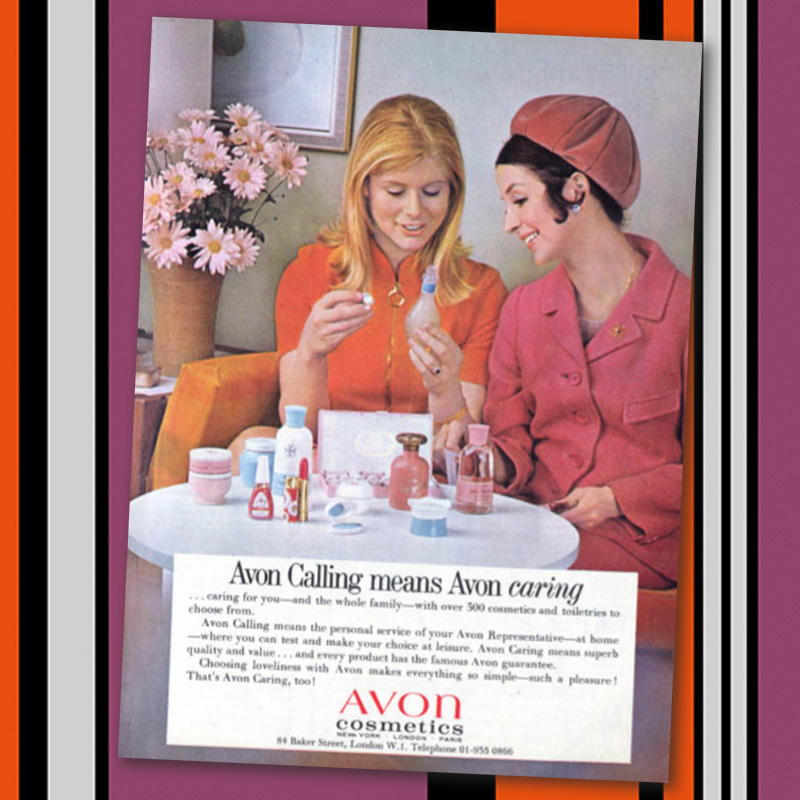
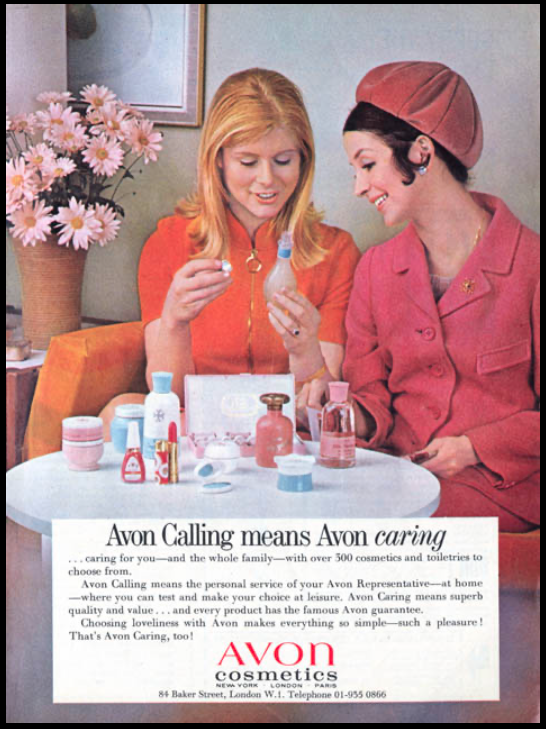
These two print ads from the end of the 1960’s demonstrate the positioning of the Avon Lady perfectly. Look at the colours, the fashion, the hats! The Avon lady in the neat suit and hat, the customer attractive, but not too glamorous. The atmosphere of relaxed, friendly viewing…
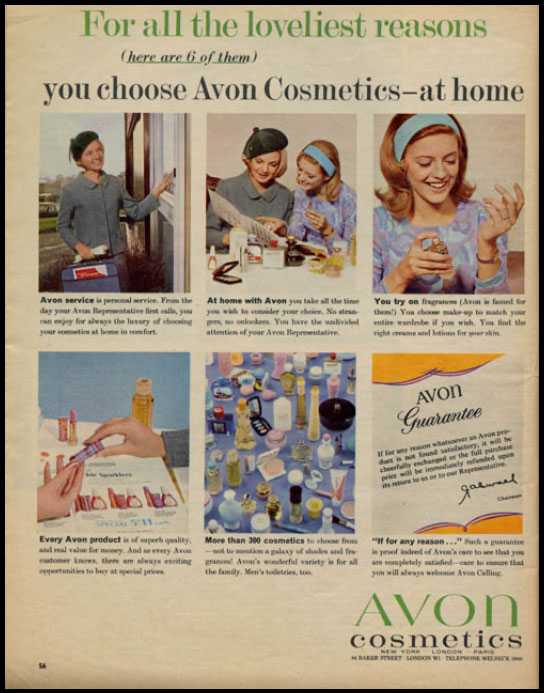
Gallery Image: Avon Cosmetics | Catalogue | History of Advertising Trust (1968)
Avon’s Image in the 1970’s
We don’t have any research in the Archive from the 1950’s and 60’s which mentions Avon but we do have reports from the1970’s which show us how Avon was positioned. Basically as a very popular mid-market, reasonably priced, good quality product for older, C2DE women, who preferred buying from catalogues/the Avon Lady.
From a 1972 report on skincare (7) we have:
For the women at home the door-to-door sales promotions such as Avon, Beauty Counsellor and Holiday Magic were a useful introduction to new trends in cosmetics and the information gained by just looking at what was available was as important as the pure selling function. Similarly, cosmetic displays and house parties were a more recent introduction to cosmetic ranges and hence to skin care products.
In the 1973 report: Qualitative Research on skin care (8):
Avon was seen as slightly less expensive, but of similar quality. (There were some doubts expressed about Avon’s skill as a manufacturer).
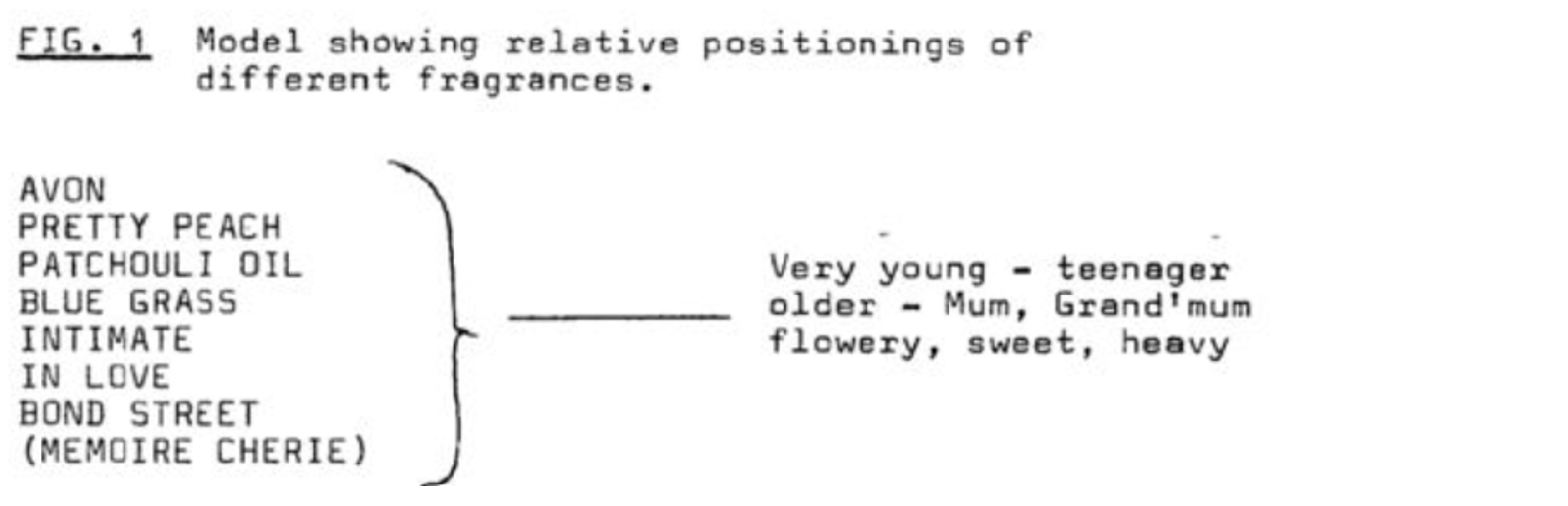
In the 1975 Qualitative Research on Memoire Cherie [Female Fragrances] for Elizabeth Arden (9) we see an interesting segmentation of Avon Fragrances:
The 1976 Concepts for a new facial cleanser (10) reported : Of the remainder of products used and discussed, Avon, Ponds, Max Factor, Astral and Nivea (lotion) were the more common/usual brands mentioned. These brands had the advantage of familiarity and availability, were seen as “safe” , unchallenging and generally inexpensive.
Here’s a lipstick ad from 1975:
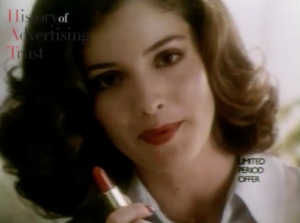
Avon Commercial: You make me smile | Catalogue | History of Advertising Trust (1975)
The 1980 UK Cosmetic Market: Survey of Consumer Behaviour and Attitudes (11) was a large (1000+ interviews) quantitative study and has more detailed findings on Avon. Do these excerpts indicate perhaps the beginning of a decline in image and popularity, or at least some ‘danger signs’ in the definition of the Avon customer base?
- Avon is particularly strong in nail, lip, and moisturisers, and has a pronounced C2DE bias
- Avon does not have a very strong image, and carries definite negatives on suitability for the skin, product quality, and colours not staying on.
- Max Factor is clearly stronger than Avon in eye shadow, mascara, foundation, and face powder. Avon is stronger only in nail varnish.
- (Rouge/blusher/shader) Avon is again skewed towards the lower social class group , and with 12%, has most buyers of any brand and amongst the older women .
- (Lip products) Very young women show particular interest in Avon, Rimmel, Charlie and Maxi. Charlie and Revlon and Elizabeth Arden are all more ABC1 in their appeal , whereas Avon and Yardley definitely show bias towards the C2DE’s. Working Status shows little interesting variation.
- Avon has a less distinctive profile, in that its scores on the positive statements are generally balanced by similar scores on the negative ones. Its most prominent features are for choice of colours (33% perceiving those as good, compared with 16% as poor) and modern (23% vs 11% old fashioned). Two particular negatives are in relation to “doesn’t suit my skin” (25%) and “poor quality products” ( 20%) .
And perhaps the most telling of all:
- Avon scores favourably on alI attributes amongst catalogue buyers. It performs correspondingly badly amongst all other buyers.
This report implies that the Avon image was solidifying, its core market was strong, but the rest of the market was not so enthused, and indeed the 1982 Fragrances Study that we have in the Archive (which was conducted for Avon) implies that Avon was aware of this , and the company was attempting to launch itself into a higher plane…
A business built on women’s networks: The Avon Lady
Looking back, Avon’s genius was simple: it recognised that in the 60’s and 70’s millions of women were at home, often isolated, often financially dependent, and often eager for small luxuries. The Avon Lady arrived not just with cologne or lipstick, but with conversation, recognition, and a sense of belonging. The 1982 qualitative study for Avon shows this clearly (1):
- Avon was “friendly”, “un-embarrassing”, “safe”, and “non‑threatening”.
- It offered “our fashion” — accessible, modest, not intimidating.
- It allowed women to buy beauty products without entering spaces where they felt judged: department stores, fashion boutiques, cosmetic counters staffed by glamorous young assistants. (Note that In fashion reports of the time many women complained that ‘assistants “pounce” on you as soon as you enter the shop’. This clearly upsets many people, making them feel pressured and under scrutiny. Some simply walk out if they get the slightest hint of pressure. “Normally I’ll walk out if they come up to me, I’ll walk out in disgust if I’m pounced upon”) (12)
Avon’s selling method was personal, domestic, and reassuring. It fitted the rhythms of women’s lives: “The Avon lady comes round to the house, so I get all different skin things from her …. it saves time and effort.” (2)
Here’s how the Avon Lady was described in the1982 study – which was conducted for Avon Colognes (1):
“The Avon representative herself is a less threatening, more reassuring figure than most cosmetic sales girls. The expertly made up cosmetic sales girls remind the Avon heartland consumers of their relative lack of sophistication, and indeed remind them of their “lost” femininity.”
“The Avon representative is a woman from their world, who talks their language. She provides a contact with the “safe” fashion of the world of the Avon consumers not the world of models, Vogue and bright young things.”
“The Avon representative also acts as the opinion leader of her network, she establishes the “rules” of cologne and cosmetic wearing and acts as the arbiter of the group identity of the Avon consumers.”
Avon’s commercial success at this time is clear from 1987 TGI consumer data. This showed 5.8 million women (25% of the female population!) using Avon lipstick, 4.2 million its eye make-up, and 3.2 million its moisturiser. Avon was brand leader in these and several other categories of toiletries and cosmetics. It is perhaps worth just showing Avon’s overall levels of usage in 1987: TGI counts ‘Most used Brand’ and Avon’s share of ‘most used’ was very good: Lipstick 20.7% of women, eye-makeup 14.1%, Talc 16.9, Nail varnish 16.1%, Moisturiser 11.6, Foundation 11.4%, Face Powder 6.4%, Suntan lotion 7.5%, Bath oils 7.3%, Hand cream 10.5%, Blusher/highlighter 9.9%, Cleanser 8.7% and so on, with lower shares for deodorant, bath-cubes, shampoo and conditioner. Also some respectable shares of men’s products (most used brand): After Shave 5.9%, Talc 4.7 %, Deodorant 3.3%.
Women’s Perfume and Toilet water was 12.8% for ‘most used’ with a further 4.2% ‘other used’. That’s 17% of women using Avon Fragrances!
The Avon Lady as a symbol of constrained independence
The CSA (Child Support Agency) Report from1991 (3) contains an interesting insight:
“I’ve started doing the Avon. I’m their Avon lady. Just need the extra money. You just have to do things, to keep yourself. They don’t understand down there (at the DSS).”
Or this from a 1984 Fashion Report for Habitat (4), about women’s budget for clothes:
“I’m an Avon lady and I count the Avon money as money to play around with. It could be a tropical fish tank or it could be a skirt.”
This is Avon at its cultural peak: a small income stream that felt like freedom. For many women — especially lone mothers, or those with restricted housekeeping budgets — Avon earnings were “my own money”, a rare pocket of autonomy in a life otherwise dominated by childcare, tight budgets, and self‑sacrifice. The Avon Lady was part entrepreneur, part neighbour, part emotional support.
The Avon products: accessible glamour
The earlier 1970’s studies and the 1982 fragrance study show how Avon positioned itself (1):
- Not cheap, but affordable.
- Not high fashion, but aspirational within reach.
- Fragrances that were “warm”, “cosy”, “romantic”, “nice for evenings in front of the fire”.
- Packaging that signalled “special” without being intimidating.
- A brand that allowed women to feel feminine without feeling judged.
Avon’s products were never about haute couture; they were about dignity, self‑care, and small pleasures.
The decline: changing lives, changing retail
Into the 1990’s and 2000’s, the world that sustained the Avon Lady began to disappear.
- Women entered the workforce in large numbers.
- Shopping became easier, more anonymous, more varied.
- Supermarkets, Boots, and department stores expanded their beauty ranges.
- Younger women became more fashion‑conscious, more brand‑driven, and less attached to door‑to‑door selling.
- Avon’s image — “housewives”, “grannies”, “aunts”, “ dowdy”, “old‑fashioned” — became a liability.
- “I sort of connect it with housewives… you know who don’t go out much, who just stop at home.”
- “I always think of old grannies… it’s the sort of thing you get from your nan for a present.”
In the 1982 study the segmentation was brutally clear: the “heartland” Avon consumer was conservative, conventional, and non‑aspirational. The “radicals” — younger, more modern, more fashion‑forward — rejected Avon as a symbol of the past. The study’s findings therefore show that Avon’s potential future weakness was not simply commercial but sociocultural: the brand remained anchored to the values of its ‘heartland’ consumers even as the wider market moved decisively toward the tastes, identities, and retail behaviours of the ‘radicals’. (1)
However, the evidence from the 1982 study is of a brand which recognised this. Modernising — shedding its dowdy past, improving fragrances, and appealing to younger, more confident women. “Avon is perceived to be marketing more aspirational products for the more self‑assured, professional, independent woman.”
We only have a proposal from 1990 – but this clearly indicates that by then Avon is ready for a pan‑European relaunch — reorganised, ambitious, and preparing to elevate (at least) its fragrance brand for the 1990s. And we must conclude (from the TGI data) that they were basically successful.
In 2012 the TGI brand usage data still showed very substantial numbers: 5.2 million users of Avon lipstick and 3.8 million users of Avon face creams and lotions, for example. At this point, 3.6 million women were still direct sales customers; of these around 10% acted as agents themselves.
But ‘The Times they were A’Changin’’, and by 2022 Avon’s direct customer base had shrunk to around 1 million. But user numbers for several products in its range – face creams, lipstick, eye make-up, handwash, nail varnish and more – still stood above 2 million (5).
The Avon Lady today
Avon still exists, but the Avon Lady — the neighbour knocking on the door with a brochure — is largely gone. The company has shifted to online sales, influencer partnerships, and digital catalogues. But the cultural figure remains iconic: a reminder of a time when women’s economic lives were tightly bounded, and when selling perfume door‑to‑door could feel like liberation.
Links to the Archive:
Mentions of ‘Avon Lady’
(4) Report on fashion market research – Page 77 – Reports of projects – The AMSR Online Archive (1984)
Mentions of ‘Avon’
(5) Quantitative consumer research: TGI (Target Group Index) – The AMSR Online Archive
(6) 1950s Vintage Avon Commercial Avon calling – Avon Calling
(7) Research report on skin care – Page 14 – The CRAM Peter Cooper Collection – The AMSR Online Archive 1972
A later proposal
Date posted: October 2026
Images and video: History of Advertising Trust (HAT) gallery