
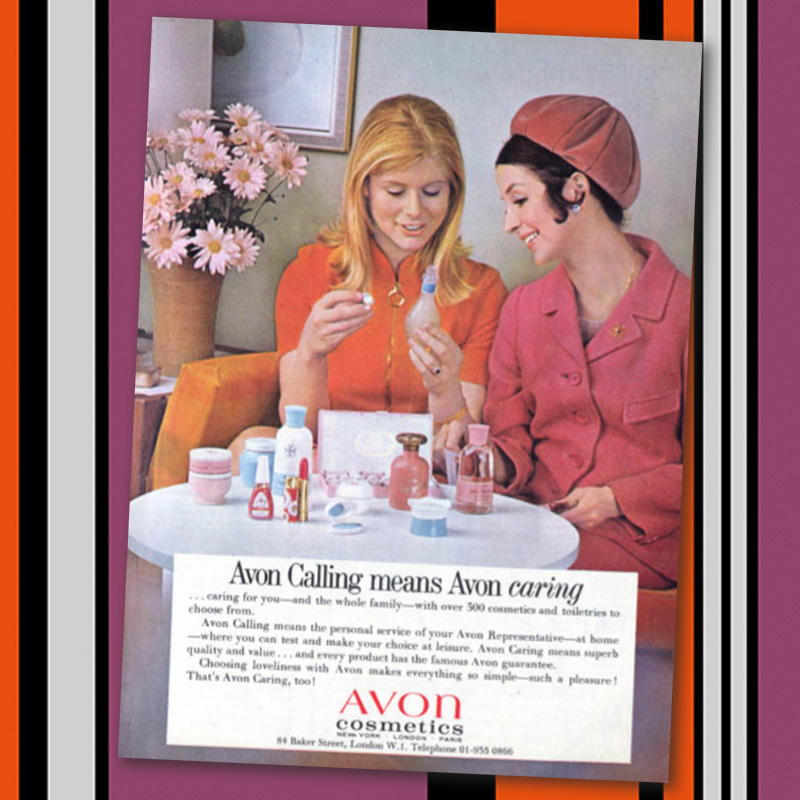
For a few decades in post‑war Britain, one sound could send women to the front door faster than the milkman or the postman: “Ding dong — Avon calling!”. Avon’s long‑running TV campaign (1954–67) turned the Avon Lady into a minor celebrity — a neatly dressed emissary of affordable glamour who arrived with a suitcase full of lipstick and a reassuring smile (6).
The Archive shows why she mattered. In qualitative work from the 1970s and 80s respondents consistently described the Avon Lady as “a woman from their world, who talks their language” — a friendly alternative to department‑store counters staffed by intimidating, perfectly made‑up salesgirls (2). Avon’s advertising echoed this: warm, domestic, non‑threatening, deliberately avoiding the aspirational gloss of Vogue‑style beauty campaigns. As the 1982 fragrance study put it, the Avon representative was “less threatening, more reassuring” than mainstream cosmetics advertising, offering glamour that felt safe and achievable (1).
Avon’s commercial success at this time is clear from 1987 TGI consumer data (5). This showed 5.8 million women (25% of the female population!) using Avon lipstick, 4.2 million its eye make-up, and 3.2 million its moisturiser. Avon was brand leader in these and several other categories of toiletries and cosmetics.
And for many women, becoming an ‘Avon Lady’, selling Avon products was a small but meaningful route to independence. A lone parent in a 1991 CSA study said simply: “I’ve started doing the Avon… just need the extra money.”(3) . Another said of her clothes budget in 1984: “I’m an Avon lady and I count the Avon as money to play around with… a tropical fish tank or a skirt.” (4). Avon wasn’t just selling cosmetics — it was selling pockets of autonomy.
But gradually, into the 1990’s and 2000’s, the social world that sustained her began to disappear. Women went out to work; supermarkets expanded their beauty aisles; younger women sought modern, fashion‑forward brands. The 1982 segmentation proved in the long term effective but blunt (1): Avon’s “heartland” consumers were conservative and conventional, and declining, while the “radicals” — younger, aspirational, style‑driven — eventually rejected the brand entirely. What once felt reassuring now felt old‑fashioned.
Even so, it took a long time, in 2012 the TGI brand usage data still showed very substantial numbers: 5.2 million users of Avon lipstick and 3.8 million users of Avon face creams and lotions, for example. At this point, 3.6 million women were still direct sales customers; of these around 10% acted as agents themselves.
By 2022 Avon’s direct customer base had shrunk to around 1 million. But user numbers for several products in its range – face creams, lipstick, eye make-up, handwash, nail varnish and more – still stood above 2 million (5).
Today, Avon still exists — online, on Instagram, through digital catalogues — but the woman with the suitcase and the brochure is mostly gone. She remains a cultural icon: a reminder of a time when selling lipstick door‑to‑door could feel like liberation, and when a simple “ding dong” could make you feel glamorous.
Sources/links to the Archive:
(4) Report on fashion market research – Page 77 – Reports of projects – The AMSR Online Archive (1984)
(5) Quantitative consumer research: TGI (Target Group Index) – The AMSR Online Archive
(6) Avon Commercial: You make me smile | Catalogue | History of Advertising Trust (1975)
Contributed by Geoff Wicken and Phyllis Macfarlane, with help from CoPilot.
Date posted: October 2026
Photo: History of Advertising Trust (HAT) gallery
A more detailed version of this story will be posted soon in our In-Depth Essays section.