

Several stories in the Archive have examined the fate of once-iconic brands that are now fading from memory. Reader’s Digest is another such brand. Founded in the USA in 1922, its first UK edition was published in 1938, appearing monthly. At its peak in 1971, the UK edition could boast a readership of 8-9 million – a penetration of 22% of the adult population – but by 1985 this had fallen to around 6.5 million or 15% of all adults. Readership was slightly, but not heavily, skewed towards men.
From the mid-1980s onwards, the drop in readership became more marked and it accelerated still further from 1997, as the chart below shows:
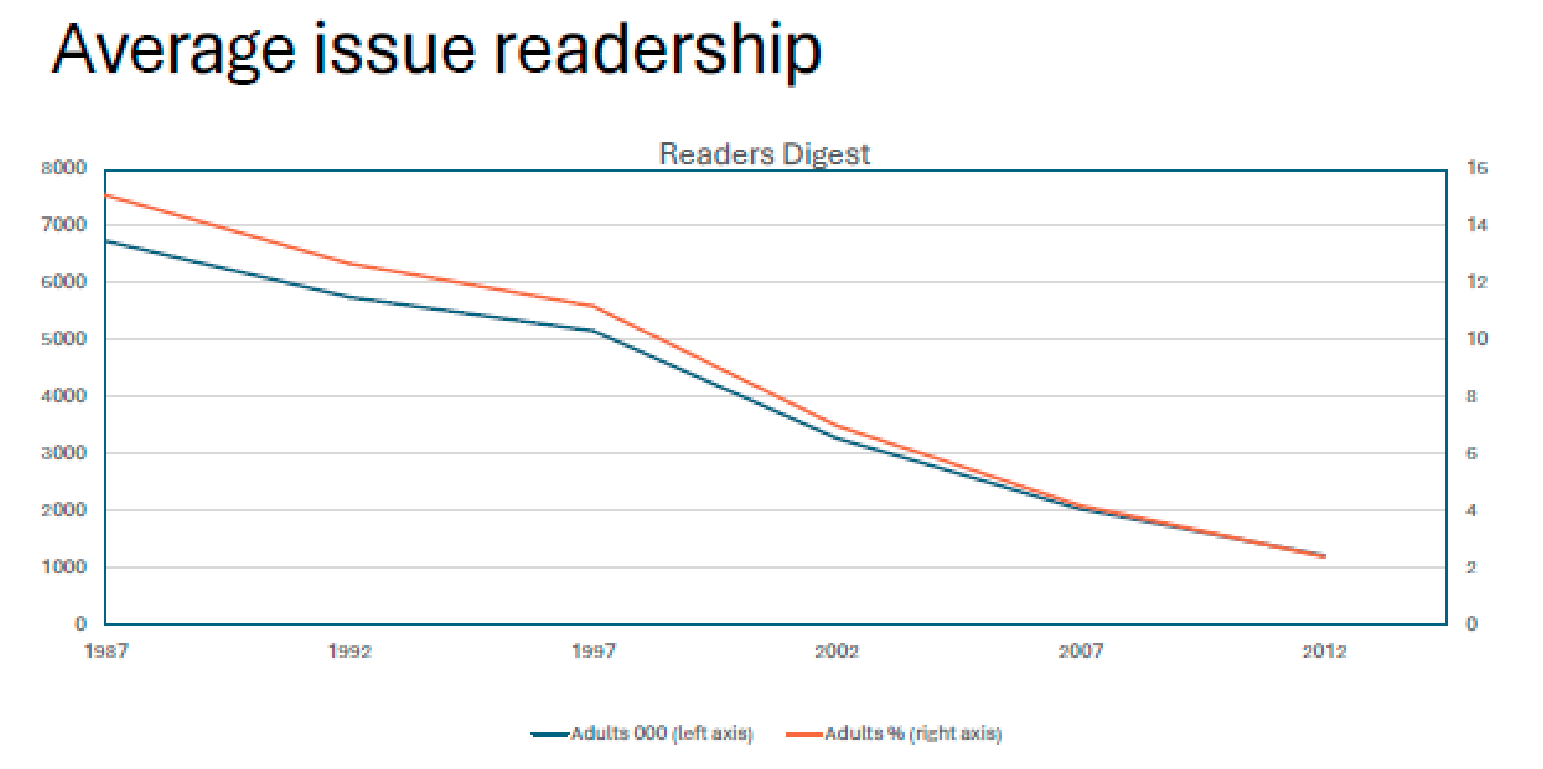
By 2012, average issue readership was only 1.2 million; in 2017, the magazine had just 794,000 subscribers.
A publication from the Professional Publishers Association promoting press advertising (52 Ways Magazines Make Things Happen) examines the role of Reader’s Digest in promoting the Oil of Ulay cosmetics brand. It suggests that the magazine’s success lay in making advertising feel like trusted editorial advice. Its thesis is that Oil of Ulay needed an “ethical educational medium” and chose Reader’s Digest because “Digest readers were affluent, well informed and with a strong belief in the magazine.” The Digest presented advertising in a way that made new products feel authoritative, credible and safe. But the very strength that made Reader’s Digest so powerful in the 1950s-70s subsequently became its weakness: as media fragmented and readers diversified, trust migrated to specialist titles and digital sources. The Digest’s quasi-educational tone, says the article, no longer matched how people consumed information and the world no longer required a magazine claiming to be a single, trusted digest.
According to Wikipedia, a pension fund deficit pushed the company into administration in 2010; it was bought by a private equity fund but after two further changes of ownership, the UK edition of Reader’s Digest finally succumbed to the financial pressures of the market, and it ceased publication in April 2024.
Sources:
30-Year Readership Patterns 1956-86, Guy Consterdine & Associates1987
TGI:
TGI (Target Group Index) is a continuous survey which has been carried out in Great Britain since 1969, based on 25,000 adults per annum, who provide information on their use of all major products, brands and services. Media exposure, attitudinal and demographic data are also included. Kantar, who own and operate TGI, have made major donations of data to AMSR. To explore the TGI archive within AMSR, click here: Target Group Index – The AMSR Online Archive (oclc.org)
All TGI data copyright © Kantar Media UK Limited 2026. All use of TGI data is subject to Kantar Media UK Limited’s terms and conditions.
Authors: Nick Tanner, Phyllis Macfarlane
Date posted: November 2026
Photo: Aizat bin Mohd Ali / Shutterstock.com