

Over the course of the 20th century newspapers grew to be a vital medium for news, information and entertainment. They also became a key tool for advertisers to reach large and specifically targeted audiences. In the 21st century competition has forced newspaper businesses to adapt their offers online. A new paper drawn from resources in AMSR traces their evolution.
The full paper How Have Audiences for Newspapers Changed Over Time? is now available as an in-Depth essay.
As a taster, we are publishing four short excerpts, of which this is the third…
Gradual decline – 1970s to 1980s
The key trends:
- Newspapers remained an important medium, read by more than half of the population
- Changes in working patterns and lifestyle impacted on peoples’ time available to read
- Competition from TV grew, as channels expanded and viewing on demand (initially through video recorders) became popular
- Newspaper titles adapted and became more targeted in demographics and outlook
- Readership decline occurred most among C2DE households and the popular tabloids
- Sunday newspapers suffered greater decline than dailies
- Younger adults, aged under 35 started to read less from the 1980s
Changes in the media landscape over this period saw TV grow rapidly, in terms of both household ownership and channels available to view. Television offered an alternative, immediate source of news and entertainment, competing for the public’s attention and leisure time. While newspaper readership remained significant for several decades, a slow, steady erosion of print sales began. Lifestyle changes, such as more women entering the workforce, and the 9-to-5 workday becoming less common, also meant people had less time for reading.
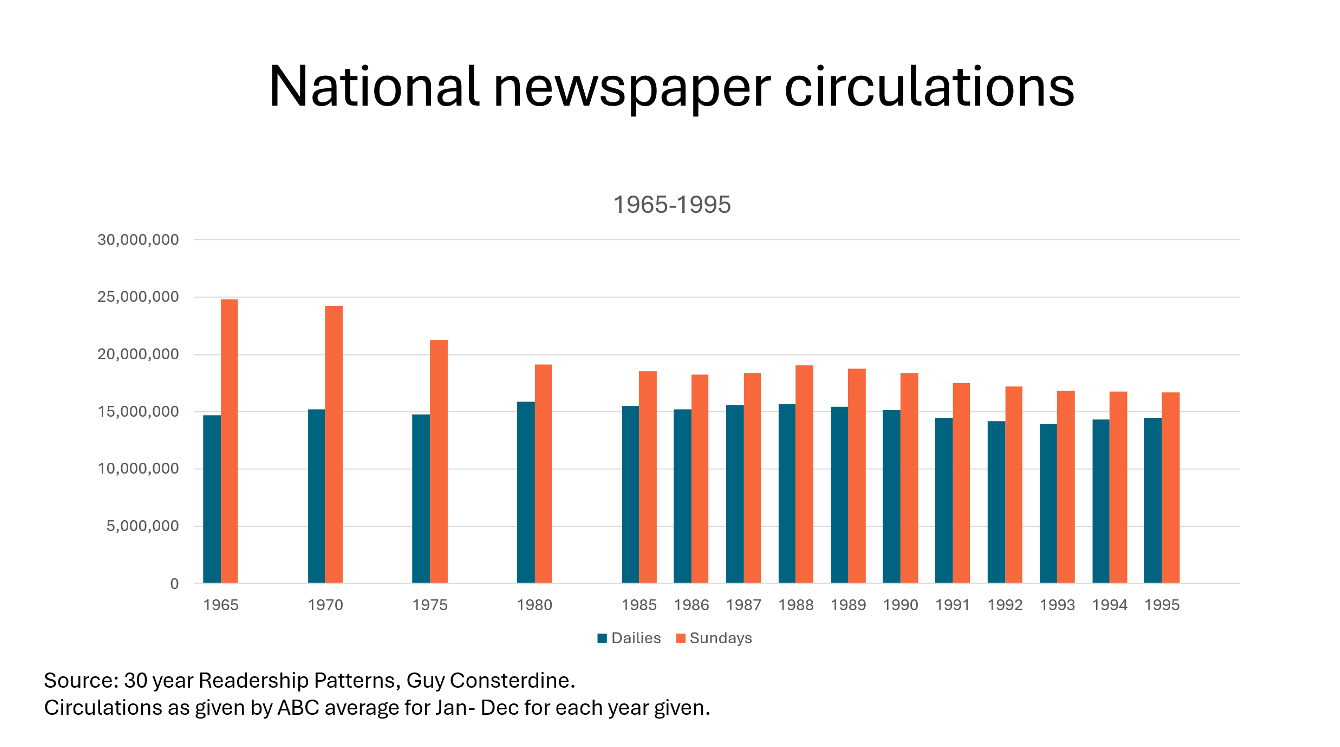
While the circulations of Monday to Saturday newspapers remained largely stable over this extended period, it was Sunday newspapers which bore the brunt, dropping by a third between 1965 and 1995. In particular, the decline came from the popular and mid-market titles.
Reading levels remained high, with newspapers still reaching large numbers of the population. While the overall numbers fell from the 1960s to the mid-1990s, the decline was relatively slow. Again it was more significant among Sunday newspapers than the dailies.
The speed of this decline varied between demographic groups. In fact readership of daily newspapers among middle class, professional or ABC1 households remained pretty stable. However, among C2DEs we can see a clear downward trend in daily newspaper readership.

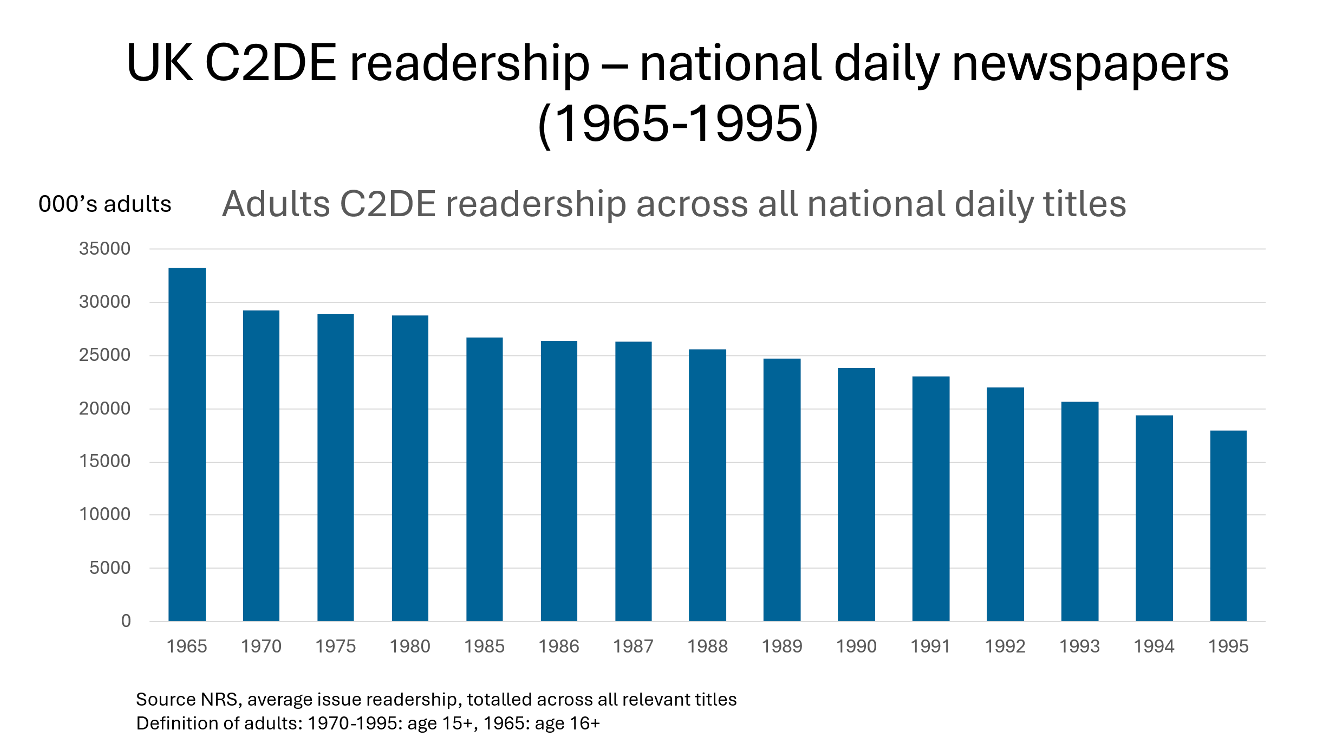
For Sunday newspapers the decline among C2DE households was even greater and this clearly had an impact on popular titles targeting this group such as the Sunday Mirror or the People.
Younger readers were also disappearing, which was a worrying indicator for all newspapers. After previous growth, from 1980 onwards the number of readers aged under 35 moved steadily downwards.

For titles such as the Daily Express with an older readership profile, the dwindling number of younger readers was a major concern. By 1995 readers aged under 35 had dropped to just 25% of a much-reduced audience.
In contrast the Guardian, targeted at a ABC1 liberal-minded audience, retained younger readers over the same period. This put the title in a good position in the late 1990s when digital media began to emerge as a serious competitor for time and attention, and as a major news source.

As readership started to fall the newspaper groups took action. The market became highly competitive with various strategies to retain and attract readers. News Group who published the Times, Sunday Times, Sun and News of the World began an aggressive pricing strategy. Other groups focused on loyalty measures, free home delivery and rewards. But there was no doubt that the trend overall was downwards and that people generally had less time to devote to reading a newspaper.
Click here to read the full paper How Have Audiences for Newspapers Changed Over Time?
Author: Liz McMahon
Date posted: November 2026
Photo: Tomas Vynikal/Shutterstock