
“The first thing, perhaps, is that appointing a Drought Minister is crucial…”
The 1976 drought was one of the most severe Britain had ever faced. Reservoirs collapsed, rivers shrank, and by late August the National Water Council judged the situation so serious that it launched a national Save the Water campaign — a mixture of advertising, public guidance, and continuous tracking research conducted by MORI.
And then something extraordinary happened. As Worcester and Mansbridge (1) record:
“As soon as the Prime Minister appointed a minister for the drought, the rains began.”
It is the perfect opening line for a story that is both serious and comic — a reminder that public communication, political symbolism, and meteorology sometimes collide in ways no research design can anticipate.
1: The Minister and the Rain: A Lesson in Symbolism
The appointment of a Minister for the Drought (2) was intended as a signal of national coordination. It was a political gesture designed to reassure the public that the crisis was being managed at the highest level.
But the moment the Minister was appointed, the weather changed. Worcester writes:
“…as soon as we started interviewing the rain started to pour down…”
The coincidence was so striking that interviewers began reporting back in irritation — not because of the rain itself, but because the carefully crafted drought‑related questions were suddenly absurd “après deluge”.
The wry lesson is clear: Symbols matter — but they can be overtaken by events.
2: The Fieldwork: Interviewers in Gum Boots
The sudden rain created a surreal research environment. Interviewers, who had prepared for dust and dryness, found themselves wading through mud and flooded lanes.
Worcester notes:
“…we were getting reports back from interviewers wading round in gum‑boots…”
The gum boots became a symbol of the campaign’s unpredictability — a reminder that even the best‑designed tracking study can be undone by external factors.
This is one of Worcester’s recurring themes: research designs must be robust enough to survive reality.
3: The Tracking Studies: What the Public Already Knew
Despite the meteorological chaos, the tracking studies produced clear findings.
a: The public already understood the seriousness of the drought.
Only 12% believed there was “no problem at all”, and 75% disagreed with the statement:
“Now we’ve had some rain the water situation isn’t so bad.”
This meant the advertising did not need to persuade the public that a crisis existed. Awareness was already high.
b: The public was already taking action.
Around 10% said they were doing “everything they could” to save water. This allowed McCann Erickson to shift quickly from awareness‑building to practical guidance — “helpful hints” rather than crisis messaging.
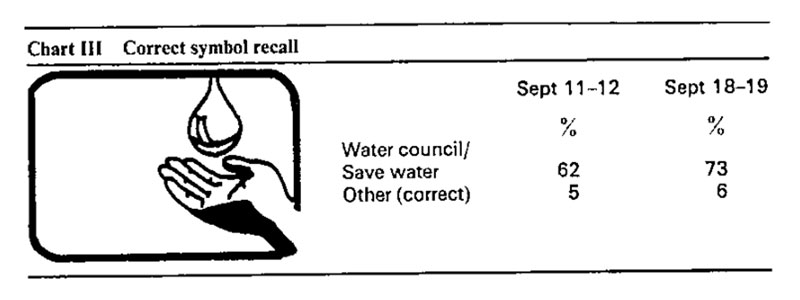
c: The Save Water symbol achieved rapid recognition.
The symbol recall rose from 62% to 73% in a single week — unusually fast for a national campaign. This gave the agency confidence to use the symbol widely across media and public signage.
4: Worcester’s Reflections: What Tracking Studies Reveal
Worcester’s broader reflections are methodological rather than dramatic. He emphasises:
- the value of continuous measurement,
- the need to adapt messaging as public understanding evolves,
- the importance of recognising external factors,
- and the inevitability of “measurement errors”, which the JMRS editorial dryly reminds us “fulfils a useful role”.
The drought campaign became a textbook example of how tracking studies can guide real‑time decision‑making — even when the weather refuses to cooperate.
5: A concluding thought
Looking back, the most striking lesson for 2026 is not methodological at all, but hilarious: the Archive had the answer all along!The tracking studies, the symbol‑recall charts, the behavioural measures — all of them mattered. But in the end, what shifted the national mood, what marked the turning point in the public narrative, was the simplest intervention imaginable. A Minister was appointed, and the rain arrived. It was coincidence, of course, but it captured something essential about British crisis management: that leadership, visibility and a single point of responsibility can do as much for public confidence as any amount of data. The Archive shows us that sometimes the smallest symbolic act is enough to change the weather — or at least to make it feel as though it has.
References:
(1) Tracking studies: basis for decision making. Robert M. Worcester and Elizabeth Mansbridge, Market & Opinion Research International (MORI) : Journal of the Market Research Society vol 19 no. 4 October – Page 25 – The MRS Journal – The AMSR Online Archive (1977)
(2) Denis Howell (from Wikipedia)
In the last week of August 1976, during Britain’s driest summer in over 200 years, he was made Minister for Drought (but nicknamed ‘Minister for Rain’). Howell was charged by the Prime Minister with the task of persuading the nation to use less water, and was even ordered by No.10 to do a rain dance on behalf of the nation. Howell responded by inviting reporters to his home in Moseley in Birmingham, where he revealed he was doing his bit to help water rationing by sharing baths with his wife, Brenda. Days later, heavy rainfall caused widespread flooding, and he became known as “Minister for Floods”. Then, during the harsh winter of 1978–1979 he was appointed Minister for Snow.
Prepared by Phyllis Macfarlane with more help from CoPilot.
Date posted: August 2026
Photo: Tomas Vynikal/Shutterstock