

Over the course of the 20th century newspapers grew to be a vital medium for news, information and entertainment. They also became a key tool for advertisers to reach large and specifically targeted audiences. In the 21st century competition has forced newspaper businesses to adapt their offers online. A new paper drawn from resources in AMSR traces their evolution.
The full paper How Have Audiences for Newspapers Changed Over Time? will be available both in the Archive and as an in-Depth essay here – link to follow.
As a taster, we are publishing four short excerpts, of which this is the first…
The 20th Century – Pre-War (up to 1939)
The key trends:
- Market expansion – by the 1930s over two-thirds of the population read a daily paper.
- Growth in reading among the working classes, to titles such as the Daily Mirror and the Daily Herald.
- The profile of readers to each title was clearly differentiated, particularly by social class.
- Radios became more prevalent and provided direct competition on news coverage.
The shape of the market in the 1920s is revealed in a 1928 report, “Press Circulations Analysed”, which shows household readership levels for the main national daily morning titles. Some of these titles are recognisable today; others have disappeared or merged into their competitors. One example is the Daily News, which was actually founded by Charles Dickens in 1843 but by 1930 merged with the News Chronicle, which in turn ceased publication in 1960 and was absorbed into the Daily Mail.
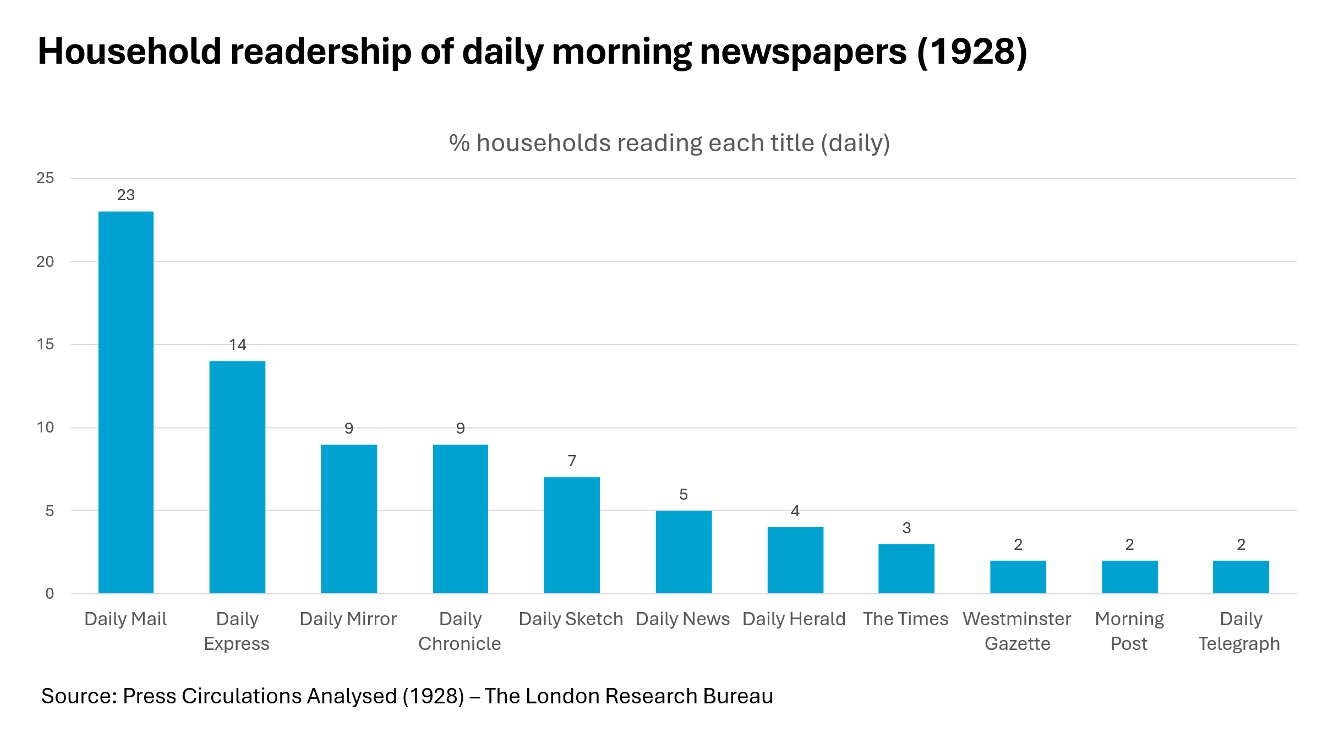
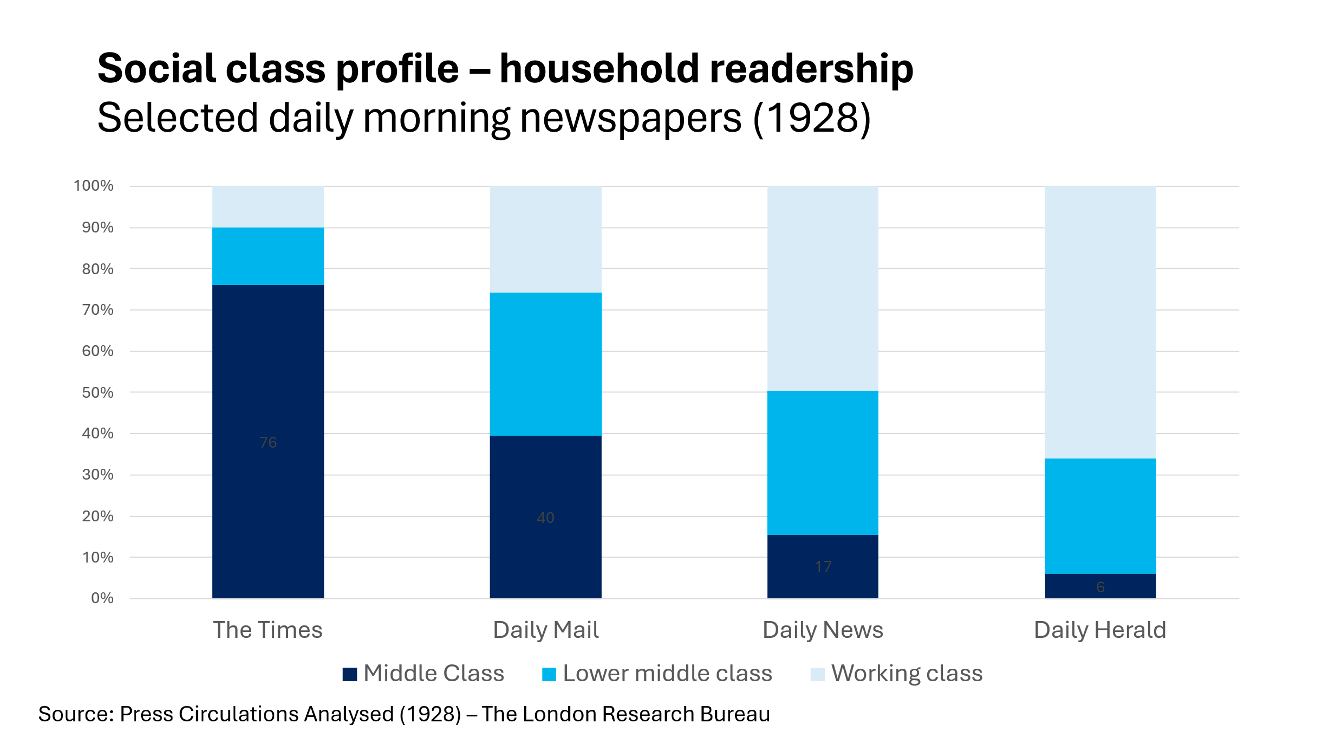
Social class was a familiar concept in the early 20th century and we can see clear differences in the audience to titles. The Times, although only typically read by about 3% of households, was clearly focused on the ‘middle classes’ with more buying power and influence. In contrast the Daily Herald strongly appealed to the working class. The Herald began publishing in 1911, initially as a daily strike bulletin in support of the printers’ union, the London Society of Compositors. Throughout its history it had links to the Labour movement and unions. In 1964 it ceased publication and later relaunched as The Sun.
Source: Press Circulations Analysed (1928) – The London Research Bureau
Growth continued in the 1930s as newspapers moved more widely into the working class market, and titles such as the Daily Herald and Daily Mirror grew in popularity. By this time newspaper readership covered a large proportion of the UK population: over two-thirds of the population read a newspaper every day with ‘almost everyone’ taking one on Sunday.
Competition was also present. Radios became a more common feature in households, and became rivals in terms of news coverage. The BBC launched in the 1920s, initially with restrictions on news reporting, but these were loosened by the time of World War Two. Consequently the news gathering operation of BBC radio expanded, and it became the leading way in which news was broken. Newspapers had to adapt their coverage to stay relevant and maintain their appeal to a large audience.
Look out for parts 2, 3 and 4 in this series, and also for the full paper, coming soon to our In-Depth Essays page. In addition you may like to browse related detail in our Media Studies A-Level page.
Author: Liz McMahon
Date posted: September 2026
Photo: Tomas Vynikal/Shutterstock